

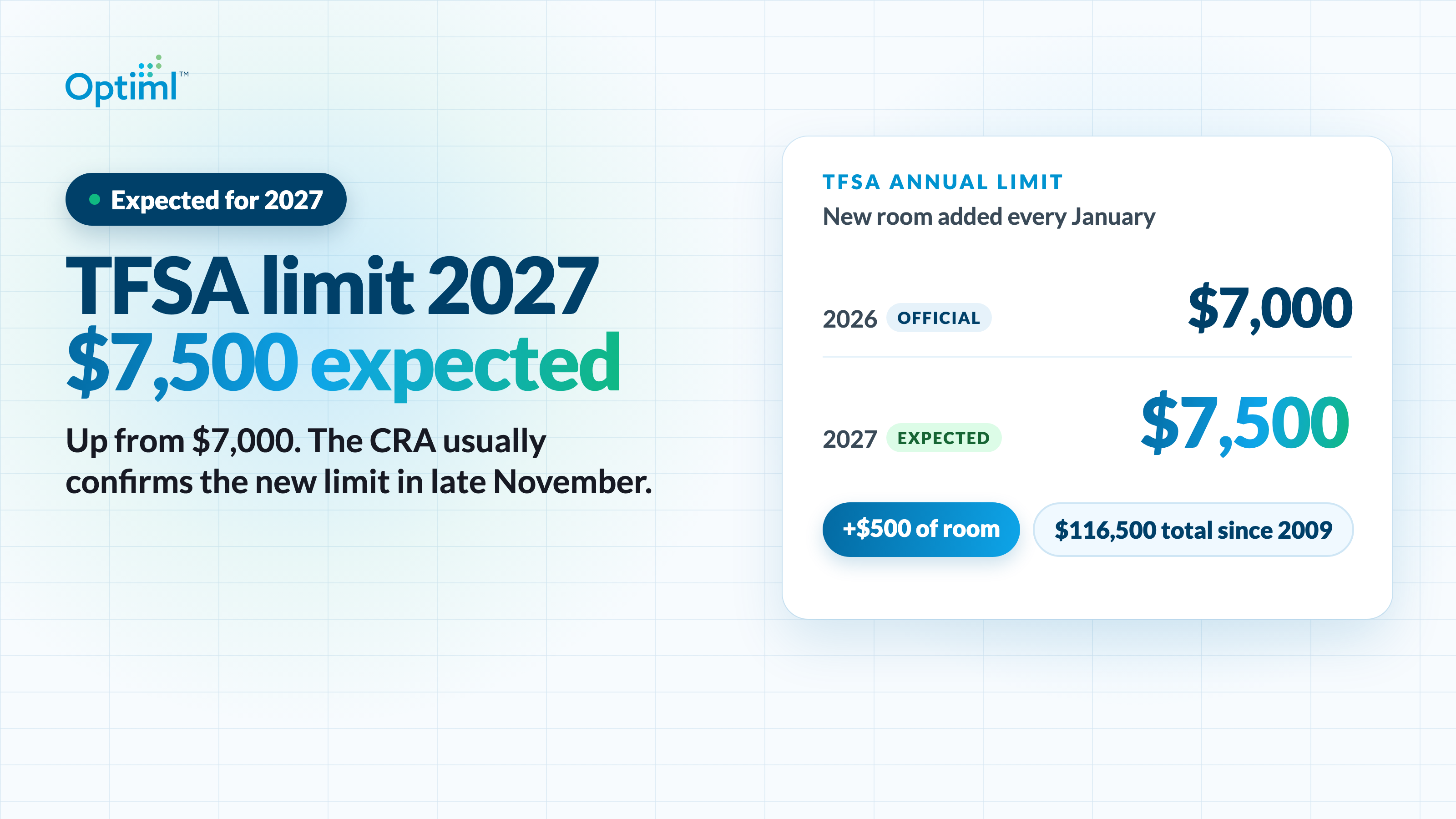
The Tax-Free Savings Account (TFSA) contribution limit for 2027 is expected to rise to $7,500, up from $7,000 in 2026. That would bring total room to $116,500 for anyone who has been eligible every year since the TFSA launched in 2009.
The Canada Revenue Agency (CRA) hasn't published the 2027 limit yet. Last year's was confirmed in late November, so expect the official number around late November 2026. Until then, $7,500 is an expectation. A firm one, and the math below shows why.
Every TFSA contribution limit since 2009
Here's every annual limit, and the total room you'd have each year if you've been eligible since 2009 and never contributed.
The 2027 row is our expectation until the CRA confirms it. Every other row is the official limit.
The limit only moves in $500 steps. That's why it sat at $7,000 for three straight years, 2024 to 2026, while prices kept rising. The one outlier is 2015, when the limit was raised to $10,000 for that year only. It went back to $5,500 in 2016.
How the 2027 TFSA limit is calculated
The TFSA limit isn't set fresh each year. It's the original $5,000 limit from 2009, indexed to inflation every year and rounded to the nearest $500.
The inflation factor is the same one used for the federal tax brackets. It compares the average Consumer Price Index (CPI) over the 12 months ending in September with the average for the 12 months before. The CRA's factors for the last four years were 6.3% for 2023, 4.7% for 2024, 2.7% for 2025 and 2.0% for 2026.
Why 2026 stayed at $7,000
Apply every one of the CRA's yearly factors to $5,000 and the unrounded 2026 amount comes to about $7,185. That's a calculation commentators have run, not a CRA figure. To round up to $7,500, it needed to reach $7,250. It fell about $65 short, so the limit stayed at $7,000.
Why 2027 is expected to reach $7,500
From $7,185, the 2027 factor only needs to be about 0.9% to clear $7,250. Based on Statistics Canada's CPI averages, it's estimated at about 2.6%. That puts the unrounded 2027 amount at about $7,372, which rounds to $7,500.
That's our arithmetic, and the CRA confirms the final figure. But the margin is wide. The factor could come in at half the estimate and the limit would still round up.
September inflation came in at 3.1% year over year, so why is the factor only about 2.6%? Because the formula averages 12 months, and September is the last of them. It also means every month in the calculation has now been published.
Two other 2027 numbers for context. The Registered Retirement Savings Plan (RRSP) dollar limit is already published at $35,390. It follows a different formula, tied to wages. And Canada Pension Plan (CPP) payments are expected to rise in January, which we broke down in CPP Increase 2027: How Much Your Payments Are Expected to Rise in January.
How to work out your own TFSA room
The $116,500 figure assumes you've been eligible every year since 2009. Your own number follows five rules.
- Room starts the year you turn 18. It starts accruing that year, as long as you're a Canadian resident with a Social Insurance Number (SIN).
- Unused room carries forward indefinitely. Skip a year and the room waits for you.
- Withdrawals come back the next year. Whatever you take out is added back to your room on January 1 of the following year, not right away.
- Over-contributions cost 1% a month. The tax is 1% per month on the highest excess amount in that month, for as long as the excess stays in.
- CRA My Account shows your room as of January 1. That figure doesn't include this year's contributions or withdrawals, so subtract anything you've put in since.
Withdrawals are where it gets tricky. Take $20,000 out in March, put it back in September, and you've over-contributed unless you had other room. We covered the full mechanics in How TFSA Contribution Room Actually Works, and the most common over-contribution mistakes in Canada Collected $166 Million on TFSA Mistakes It Could Have Prevented.
Should you fill the extra $500?
More room is an option, not an instruction.
Whether your next dollar belongs in a TFSA depends on your tax bracket today versus in retirement, your RRSP room, and when you'll need the money. We tested the always-max-it rule against an Optiml plan in our post on maxing out your TFSA every year. And if you're closer to retirement with a lot of unused room, we ran a 55-year-old with $40,000 in their TFSA and $109,000 of room through Optiml to see what catching up did to their lifetime taxes and estate.
How Optiml keeps track of your TFSA room
Tracking TFSA room by hand means redoing the math every January, for every year you're planning ahead. Optiml does it in every plan.
Your plan projects your TFSA room year by year, the way the rules work. Each January adds a new annual limit, indexed to your plan's inflation assumption and rounded to the nearest $500. So the limit keeps stepping up in $500 increments through your whole plan, and those increases are projected long before they're announced.
- Contributions use up room. Every dollar your plan puts into your TFSA comes off that year's room.
- Withdrawals come back the following January. Room you free up in one year reappears on January 1 of the next, across your whole retirement.
- Your starting room is calculated for you. When you set up your TFSA, Optiml can work out your total room from the year you became eligible, using the CRA's official limit for every year since 2009 and skipping any years you weren't eligible.
- Official limits go in as soon as they're published. When the CRA confirms the 2027 limit, we update it in Optiml.
Tracking the room is half the job. Using it well is the other half. Optiml works out how much to put into and take out of your TFSA, your RRSP or Registered Retirement Income Fund (RRIF), and your non-registered accounts each year to lower your lifetime tax bill. And EVA, Optiml's AI assistant, answers what-ifs on your own plan, like "what if I max my TFSA every year?"
The Bottom Line
The TFSA contribution limit is expected to rise to $7,500 in 2027, taking total room since 2009 to $116,500. The CRA should confirm it around late November.
That limit is the same for every Canadian. Your room isn't. It depends on when you became eligible, what you've put in and what you've taken out. Optiml keeps count for you, every year of your plan.
The limit is everyone's. The room is yours.
Frequently asked questions
What is the TFSA contribution limit for 2027?
It's expected to be $7,500, up from $7,000 in 2026. The 2027 inflation factor is estimated at about 2.6%, well above the roughly 0.9% needed for the indexed limit to round up to $7,500. The CRA hasn't published the official figure yet.
What is the total TFSA contribution room in 2027?
Total room is expected to be $116,500 in 2027, up from $109,000 in 2026, for someone who has been eligible every year since 2009 and never contributed. Your own room depends on the year you became eligible, what you've contributed and what you've withdrawn.
How is the TFSA limit calculated?
The original $5,000 limit from 2009 is indexed every year by the same inflation factor as the federal tax brackets, based on average CPI over the 12 months ending in September compared with the 12 months before. The indexed amount is rounded to the nearest $500. For 2026 it came to about $7,185, short of the $7,250 needed to round up, so the limit stayed at $7,000.
When will the CRA announce the 2027 TFSA limit?
Last year's limit was confirmed in late November, so expect the 2027 limit around late November 2026. The new annual limit is added to your room on January 1, 2027.
How do I check my TFSA contribution room?
Your room is shown in CRA My Account, but that figure is as of January 1. It doesn't include this year's contributions or withdrawals, so subtract anything you've contributed since. Withdrawals are added back on January 1 of the following year, and over-contributions are taxed at 1% per month on the highest excess amount in the month.
Ready to optimize your retirement plan?
Join thousands of Canadians making smarter financial decisions with Optiml.
Start Free Trial