

Every few weeks, someone messages us convinced they found a bug in Optiml. The story is almost always the same. Their plan recommended pulling money from their TFSA (Tax-Free Savings Account) to fund something big, often a home purchase. They follow the plan. Then the next January, they log in and see a huge amount of contribution room reopen. Far more than the annual limit. Sometimes tens of thousands of dollars more.
"That can't be right," they say.
But it is right. It is not a bug. It is exactly how the TFSA is designed to work, and it is one of the most misunderstood rules in the whole account. Once you see the mechanic clearly, you stop second-guessing the number and start using it on purpose.
The rule a lot of Canadians get wrong
A lot of Canadians assume their TFSA contribution room goes up and down with their investments. It doesn't. Your room is completely separate from what your money is doing inside the account.
TFSA room only changes when you contribute or when you withdraw
There are exactly two things you can do that move your contribution room:
- You contribute. Your available room goes down by the amount you put in.
- You withdraw. Your available room goes up, but not until the following year (more on the timing below).
That's it. Every January 1, the government also adds that year's new annual limit on top. For 2026, the annual limit is $7,000. If you have been eligible every year since the TFSA launched in 2009 (18 or older and a Canadian resident) and never contributed, your cumulative room is roughly $109,000.
Investment gains and losses do not change your room
This is the part people miss. If you contribute $7,000 and it grows to $9,000 inside the account, your room did not shrink by $9,000. It shrank by the $7,000 you contributed. The $2,000 of growth is yours, tax-free, and it never counted against your room.
The same is true in reverse. If that $7,000 falls to $5,000, you still used $7,000 of room. The market moving your balance around does nothing to the room number by itself. Room reacts to your actions (contributions and withdrawals), not the market's.
Why withdrawn room comes back bigger than you expect
Here is the mechanic that makes people think something broke.
You get back the full amount you withdrew, including any growth
When you withdraw from your TFSA, the amount added back to your room is the full dollar amount you took out, not the amount you originally put in. Growth included.
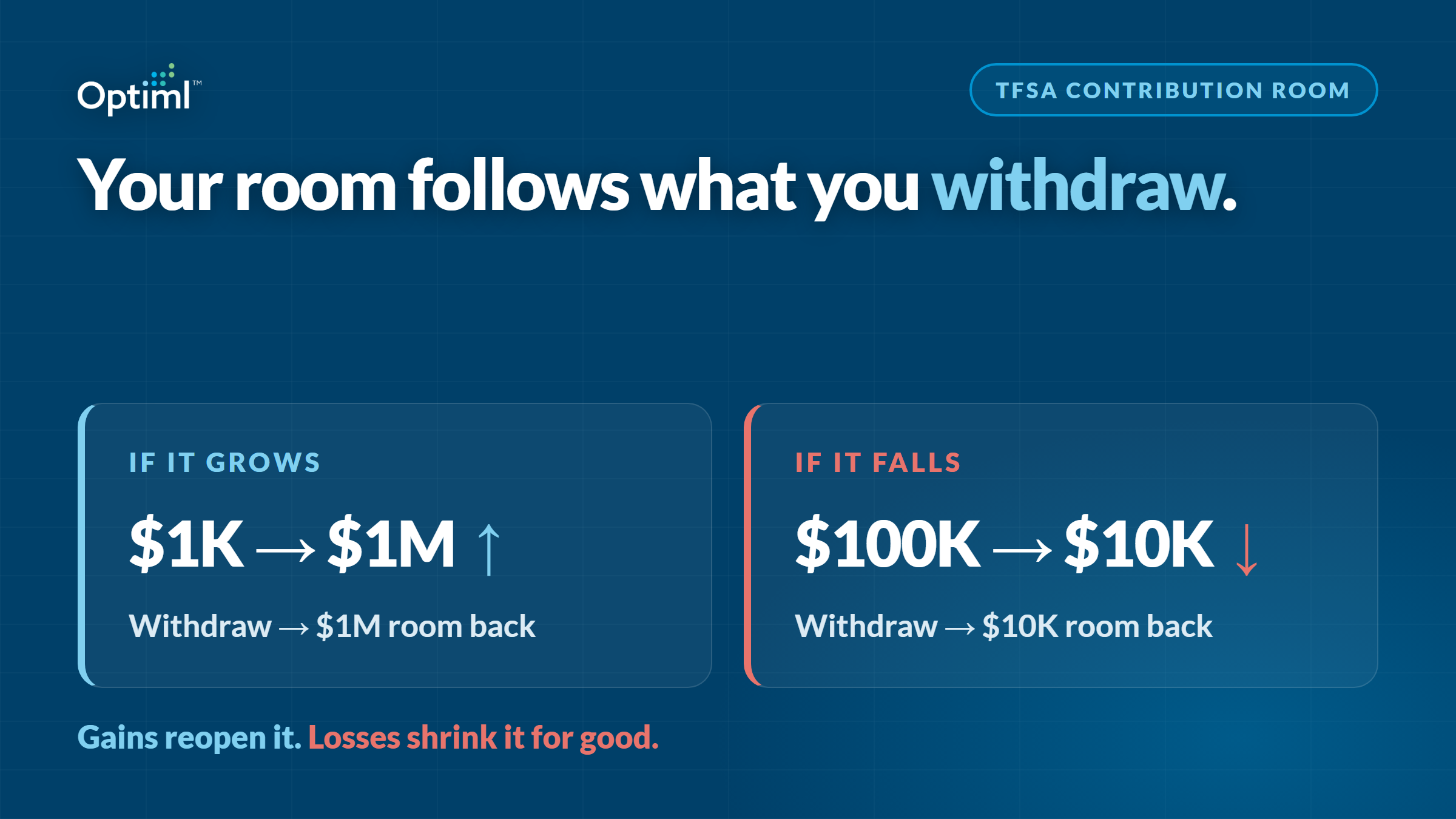
Take it to the extreme to make it obvious. Say you put $1,000 into your TFSA and, over many years, it grew to $1,000,000. If you withdraw the entire $1,000,000 to buy a house, your contribution room goes up by $1,000,000. Not $1,000. The room you get back is based on what you take out, not what you put in.
That is why a planned withdrawal can reopen a number that looks impossibly large. The growth that was sheltered inside the account effectively lets you "lock in" that room by withdrawing it.
The room comes back on January 1 of the following year
Timing matters more than anything else here. Withdrawn room is not restored the moment you take the money out. It comes back on January 1 of the next calendar year.
So if you withdraw in July, that room sits unavailable for the rest of the year and reappears the following New Year's Day, stacked on top of the fresh annual limit. This one detail is where the real trouble starts, which we will get to below.
The asymmetry most people miss
If gains reopen room, it is tempting to assume losses do the opposite in some neat, symmetrical way. They don't. The system is lopsided, and not in your favour when things go badly.
Losses permanently shrink your room
Because the room you get back equals what you withdraw, a loss inside the account costs you room you never get back.
Say you contribute $100,000 and the investments fall to $10,000. If you withdraw that $10,000, the room restored next January is only $10,000, not the $100,000 you originally put in. The other $90,000 of room is gone for good. There is no mechanism to recover it.
Put the two cases side by side and the asymmetry is stark.
Gains help you, losses hurt you, and they do it asymmetrically. Growth can multiply your room. A loss quietly deletes it.
The rules that keep you out of trouble
Two practical rules follow directly from the timing mechanic, and both are easy to trip over.
Don't re-contribute the same year you withdrew
Because withdrawn room only comes back the following January 1, putting that money back in the same calendar year (beyond room you already had available) is an over-contribution. The Canada Revenue Agency charges 1% per month on the excess amount for every month it stays in the account.
This catches people constantly. They withdraw $20,000 in March, change their mind in September, and put it back thinking they are simply restoring their own money. They are not. They are over-contributing, and the penalty runs until they either withdraw the excess or the new year restores the room. The fix is simple: if you want to put a withdrawal back, wait until the new year.
Track your own room, because CRA's My Account can lag
Your TFSA room shows up in the Canada Revenue Agency's My Account, but that figure is not always current. It updates after financial institutions report your activity, which often means it does not reflect the current year's contributions and withdrawals right away, especially mid-year.
Treat the CRA number as a starting point, not gospel. If you have been active this year, do the arithmetic yourself rather than trusting a figure that may be months behind.
What this means for what you hold in your TFSA
The asymmetry has a quiet consequence for how you think about the account. Since a loss inside a TFSA permanently costs you contribution room while a gain never reduces it, the account rewards long-term, quality growth and punishes big swings that end in a withdrawal at a loss.
That doesn't mean there is one correct thing to hold. It is a personal decision that depends on your whole picture. But as a general planning idea, the TFSA is a poor home for money you might gamble or trade in and out of at a loss, and a strong home for assets you intend to hold and let compound. Which account holds your growth is worth thinking about on purpose rather than by default.
How Optiml models this for you
This is exactly the kind of detail that is easy to get wrong by hand and easy to get right when a plan is doing the accounting for you. Optiml models your TFSA room year by year across your entire retirement horizon, tracking every contribution, every withdrawal, and the room that reopens the following January, so the number you see is the number the rules actually produce.
When Optiml recommends funding a goal like a home purchase from your TFSA, it is because it modelled the optimal, most tax-efficient account to draw from across your full income picture, weighing your TFSA against your RRSP (Registered Retirement Savings Plan), your RRIF (Registered Retirement Income Fund), and your non-registered accounts. That is the moment users see the room reopen and assume something broke. It didn't. The plan is simply following the rule correctly.
With Compare Plans, you can put two approaches side by side and watch how each one moves your room, your taxes, and your long-term outcome differently. It turns "that can't be right" into a plan you can count on.
The Bottom Line
Your TFSA room is not a scoreboard of your investment returns. It moves when you contribute and when you withdraw, and the amount that reopens is whatever you took out, restored the following January. Grow inside it and you can multiply your room. Lose inside it and you lose that room for good.
The account isn't complicated once you know the rule. It's just that most people never learned the rule.
Now you have.
Ready to optimize your retirement plan?
Join thousands of Canadians making smarter financial decisions with Optiml.
Start Free Trial