

Updated October 2026.
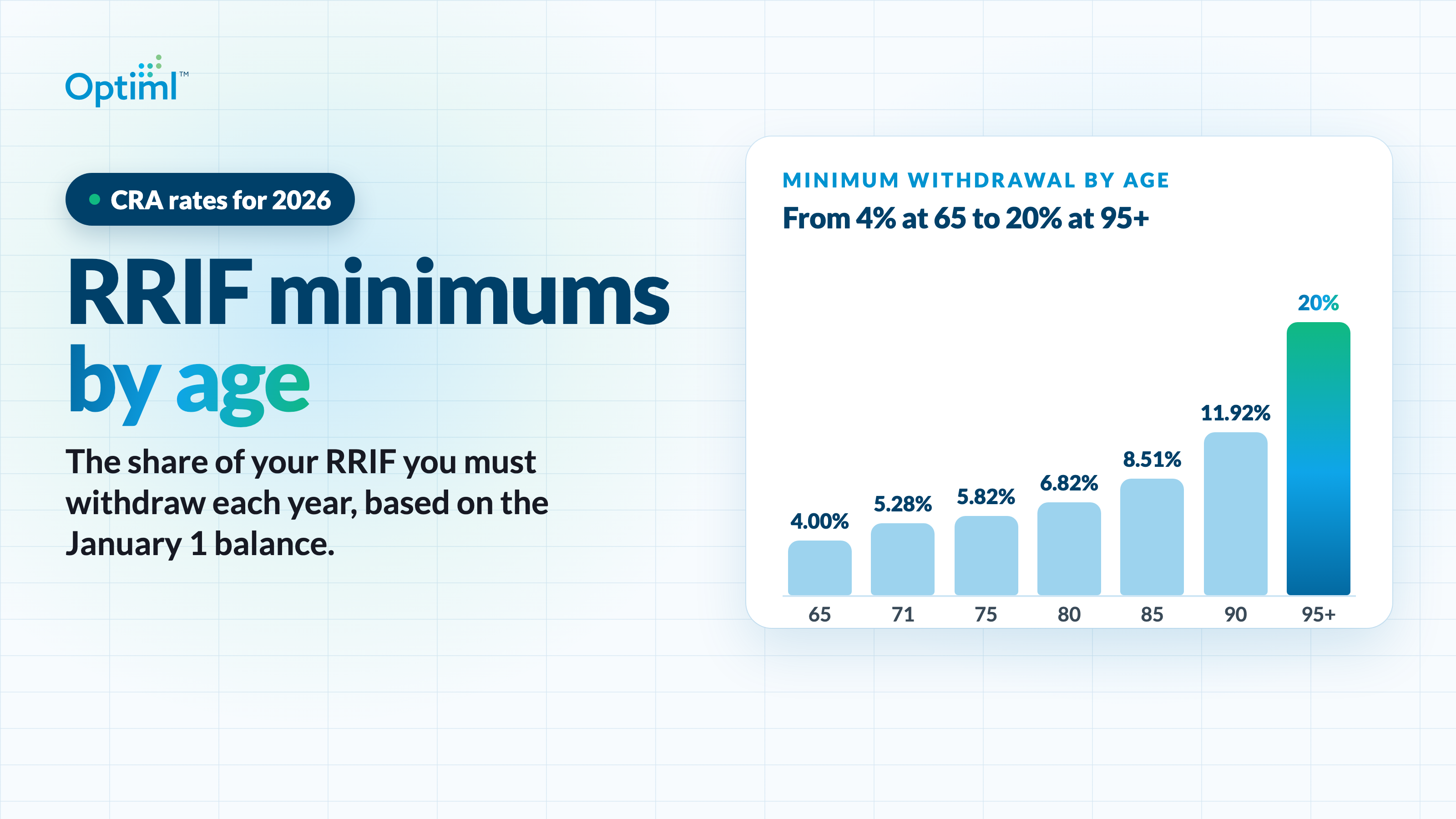
Your RRIF (Registered Retirement Income Fund) minimum withdrawal is your balance at the start of the year multiplied by a factor set by your age. Before 71, the factor is 1 ÷ (90 − your age). From 71, it comes from the CRA (Canada Revenue Agency) prescribed factors, starting at 5.28% at 71 and rising to 20% at 95 and over.
The factors are unchanged for 2026. Below are the RRIF withdrawal rates for every age from 55 to 95 and over, what each one means on $100,000, and the younger-spouse rule that can lower your minimum.
RRIF minimum withdrawal table 2026, by age
Ages 55 to 70 use the formula 1 ÷ (90 − age). Ages 71 and over use the CRA's prescribed factors. Age means your age in whole years on January 1.
Dollar figures for ages 55 to 70 use the exact formula, so some differ by a few dollars from the rounded percentage. A small number of older plans (RRIFs set up before March 1986, and "qualifying" RRIFs) use a slightly different column, for example 5.26% at 71. Nearly all RRIFs use the standard factors shown. Source: Canada Revenue Agency, chart of prescribed factors.
How the RRIF minimum withdrawal is calculated
Three things set your minimum for the year:
- Your RRIF's value at the start of the year. The CRA uses the fair market value at the beginning of the year. In plain terms, your January 1 balance. Markets can move all year; that year's minimum doesn't.
- Your age on January 1, in whole years. Or your younger spouse's age, if you elected it.
- The factor for that age, from the table above.
Multiply your balance by the factor and you have the least you must withdraw by December 31.
Before 71: a simple formula
Under 71, the factor is 1 ÷ (90 − age). At 60, that's 1 ÷ 30, or 3.33%. At 65, it's 1 ÷ 25, or 4.00%. By 70, it reaches 5.00%.
From 71: the CRA RRIF minimum withdrawal table
At 71, the prescribed factors take over at 5.28%, a small step up from 5.00% at 70. They rise every year after that, pass 10% at 88, and hold at 20% from 95 on.
To use the table as a quick RRIF calculator by age, take the dollar figure for your age and scale it to your balance. A $350,000 RRIF at 75 is 3.5 times $5,820, a minimum of $20,370.
RRIF minimum withdrawal examples
Same $500,000, different ages
Imagine a RRIF worth $500,000 on January 1.
- At 72: 5.40% gives a minimum of $27,000.
- At 65: 4.00% gives a minimum of $20,000.
Same balance, $7,000 apart, purely on age. And every dollar of that minimum is taxable income, whether you need the money that year or not.
Watch the percentage climb
Hold a RRIF at a flat $100,000 and the minimum rises from $5,280 at 71 to $8,510 at 85, then $20,000 a year from 95. That's arithmetic, not a forecast. Real balances move with markets and shrink as you withdraw. But it shows the shape: after 71, the share of your RRIF you're required to take out goes up every year until 95.
The spouse-age rule: basing your minimum on a younger spouse
If your spouse or common-law partner is younger than you, you can base your RRIF minimum on their age instead of yours. Younger age, lower factor, smaller required withdrawal.
Two conditions come with it:
- Timing. You have to make the election before you receive any payment from the RRIF. In practice, that's when you set it up.
- Permanence. Once made, it can't be changed, even if your spouse passes away.
Imagine you're 72 on January 1, your spouse is 65, and you elected your spouse's age when you set up the RRIF. On a $500,000 balance, your factor is 4.00% instead of 5.40%. Your minimum is $20,000 instead of $27,000: $7,000 less forced into your taxable income that year.
But a lower minimum isn't a lower tax bill. It's deferral. The $7,000 stays invested and stays taxable, and it comes out in a later year, at whatever your rate is then.
Because you can always withdraw more than the minimum, a lower floor gives you more room to choose, not less. What it can't do is tell you how much to take. That's a planning question, and we'll come back to it below.
RRIF withdrawal rules at a glance
- Convert your RRSP to a RRIF by 71. Your RRSP (Registered Retirement Savings Plan) has to be converted to a RRIF, withdrawn, or used to buy an annuity by December 31 of the year you turn 71. A direct transfer from RRSP to RRIF isn't taxed, and nothing is withheld.
- No minimum in year one. The minimum is nil in the calendar year you set up the RRIF. Turn 71 in 2026 and you set up the RRIF by December 31, 2026, then take your first minimum in 2027 at 5.28% (you're 71 on January 1, 2027).
- Converting earlier is allowed. You can convert at 65, or at any age before 71. Your first minimum arrives the year after you convert.
- More than the minimum is allowed. There's no maximum on a regular RRIF. Anything above the minimum is an "excess amount," and that's where withholding tax applies. Locked-in LIFs (Life Income Funds) also have a yearly maximum; here's how locked-in accounts work.
- You set the schedule. Your RRIF withdrawal schedule (some institutions call it a payout schedule) is set up with your financial institution: monthly, quarterly or once a year. The total for the year just has to reach your minimum.
- Your spouse can carry it on. If your spouse or common-law partner is named successor annuitant, the RRIF continues in their name.
Turning 71 this year? We ran the RRSP-to-RRIF deadline through Optiml to see what the tax bill looked like.
How RRIF withdrawals are taxed and withheld
No tax is withheld on your RRIF minimum. That doesn't make it tax-free.
Every dollar you take from a RRIF, minimum included, is taxable income for the year. Withholding is only a prepayment. The actual tax is settled on your return, at your marginal rate.
Withholding applies only to the amount you take above the minimum:
In Quebec, provincial tax is also withheld on top of the federal portion.
Take $10,000 above your minimum in one payment, outside Quebec, and $2,000 is withheld. If your marginal rate is higher than 20%, you'll owe the difference when you file. Take only the minimum and nothing is withheld at all, so plan for the tax on it at filing time.
What changes at 65
If you're 65 or older on December 31, your RRIF payments count as eligible pension income. That unlocks two things:
- The federal pension income amount, a tax credit on up to $2,000 of eligible pension income.
- Pension income splitting, which lets you report up to half of it on your spouse's return using form T1032. Here's how pension income splitting works.
Before 65, RRIF payments generally don't qualify for either.
RRIF income and the OAS clawback
RRIF withdrawals also count toward the net income used for the OAS (Old Age Security) recovery tax, often called the clawback. A rising minimum stacked on CPP (Canada Pension Plan), OAS and any workplace pension can push you toward the threshold. Our 2026 OAS clawback guide covers the thresholds and how to manage them.
Minimum or more? How a plan decides
It's tempting to treat the minimum as the plan: take what's required, pay the tax, repeat. It sounds disciplined. But the table tells you the least you have to take. It doesn't tell you what you should take.
Every dollar in a RRIF is taxed eventually, either as a withdrawal in a later year or on your final return. Taking only the minimum doesn't decide whether that tax gets paid. It decides when, and at what rate.
That's why a well-built plan often takes more than the minimum in some years:
- Filling low brackets before CPP and OAS start. The years between retiring and starting your benefits can carry the lowest taxable income of your adult life. Unused low brackets don't carry forward.
- Converting part of your RRSP before 71. RRIF income at 65 qualifies for the pension income amount and splitting; straight RRSP withdrawals don't. Here's the case for a partial conversion before 71.
- Running an RRSP Meltdown. Drawing registered accounts down on purpose, at lower rates, shrinks the minimums waiting in your late 70s and 80s. Here's how the RRSP Meltdown works.
- Using a spouse's lower income. Two tax returns mean two sets of low brackets to fill.
- Protecting OAS later. A smaller RRIF means smaller forced withdrawals in the years the recovery tax would apply.
Money you withdraw but don't spend can move into a TFSA (Tax-Free Savings Account) if you have contribution room, where it grows tax-free and its withdrawals don't count toward the OAS threshold. We walked through how these pieces play out over a decade in the RRIF tax traps waiting in your 70s.
This is the decision Optiml is built to model. Every Optiml plan applies these same CRA factors, and 1 ÷ (90 − age) before 71, to every year of your plan, with no minimum in the year a RRIF opens. You choose the age you convert your RRSP to a RRIF, and your plan asks: Do you want to use your spouse's age for the RRIF minimum withdrawal amount? The RRIF minimum table it uses is on your plan's Assumptions page, so you can check it against this one.
From there, Optiml models your whole retirement horizon, every account and every year, and sets the withdrawal order to minimize your lifetime taxes. If taking more than the minimum in your 60s and early 70s is what lowers that total, your plan shows it. If the minimum is the better path, it shows that too. You can run it on your own numbers with a 14-day free trial.
The Bottom Line
The RRIF minimum is simple arithmetic: your January 1 balance times a factor for your age. 4.00% at 65. 5.28% at 71. 8.51% at 85. 20% from 95.
Everything around that number is a decision. When you convert. Whether you elect a younger spouse's age. How much you take above the floor, and in which years. Those choices decide how much of your RRIF you keep after tax.
Optiml models them together, across every year of your plan.
The table sets your minimum. Your plan should set the amount.
Frequently asked questions
How much do I have to withdraw from my RRIF each year?
Your minimum is your RRIF's value at the start of the year multiplied by the factor for your age on January 1. Before 71, the factor is 1 ÷ (90 − age), which is 4.00% at 65 and 5.00% at 70. From 71, the CRA's prescribed factors apply: 5.28% at 71, 6.82% at 80 and 20% at 95 and over. On a $500,000 RRIF at 72, the minimum is $27,000.
Is the RRIF minimum withdrawal taxed?
Yes. Every RRIF payment, minimum included, is taxable income for the year. No tax is withheld on the minimum itself, so the tax on it is settled when you file your return. Withholding applies only to amounts you take above the minimum.
Can I withdraw more than the RRIF minimum?
Yes. There's no maximum on a regular RRIF. Outside Quebec, tax is withheld on amounts above the minimum at 10% on amounts up to $5,000, 20% on amounts over $5,000 up to $15,000, and 30% on amounts over $15,000. In Quebec the federal portion is 5%, 10% and 15%, and provincial tax is also withheld. Withholding is a prepayment, not your final tax.
Can I use my spouse's age for my RRIF minimum?
Yes, if your spouse or common-law partner is younger. You must make the election before you receive any payment from the RRIF, and it can't be changed afterwards, even if your spouse passes away. A 72-year-old with a 65-year-old spouse would use 4.00% instead of 5.40%: $20,000 instead of $27,000 on a $500,000 RRIF.
When do I have to convert my RRSP to a RRIF?
By December 31 of the year you turn 71, your RRSP must be converted to a RRIF, withdrawn, or used to buy an annuity. A direct transfer to a RRIF isn't taxed and has no withholding. You can also convert earlier, at 65 for example, and your first minimum is the year after you convert.
Is there a RRIF minimum in the year I open it?
No. The minimum is nil in the calendar year the RRIF is set up. If you turn 71 in 2026 and set up your RRIF by December 31, 2026, your first minimum is in 2027, at 5.28%, because you're 71 on January 1, 2027.
What is the RRIF minimum before age 71?
Before 71, the factor is 1 ÷ (90 − age), using your age in whole years at the start of the year. That works out to 2.86% at 55, 3.33% at 60, 4.00% at 65 and 5.00% at 70.
Did the RRIF minimum withdrawal change in 2026?
No. As of October 2026, the standard prescribed factors are in force with no enacted change. The only change in recent years was a one-time 25% reduction for 2020, and the 2026 Spring Economic Update left the RRIF schedule untouched.
Ready to optimize your retirement plan?
Join thousands of Canadians making smarter financial decisions with Optiml.
Start Free Trial