

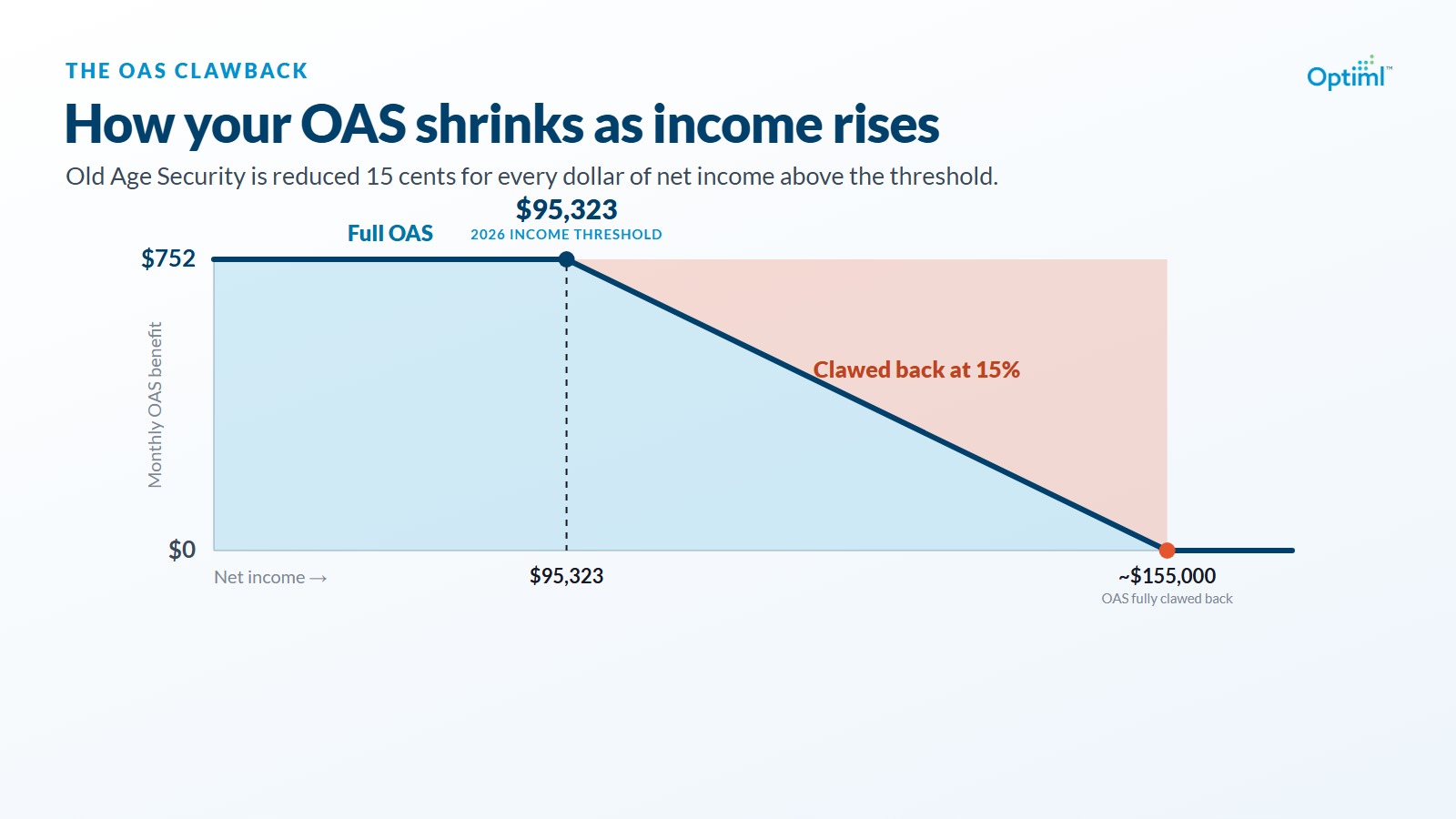
If your retirement income climbs past a certain line, the Canada Revenue Agency reduces your Old Age Security. Most Canadians hear that and assume it is a fixed penalty they simply have to accept once their income is high enough. It isn't.
The Old Age Security (OAS) clawback, formally the OAS recovery tax, responds to one number: your net income. And your net income is one of the most controllable figures in your entire retirement, if you plan for it across years rather than react to it after a bad one.
This is the practical guide. The exact 2026 numbers, who the recovery tax actually hits, and seven legitimate ways to manage it.
What the OAS clawback actually is
Start with what it is not. The OAS clawback is not a separate bill that lands in your mailbox. It is a reduction of a benefit you would otherwise receive, administered through CRA and Service Canada.
Here is the mechanic. Once your net income for a year passes a set threshold, your OAS is reduced by 15 cents for every dollar above that line. The reduction applies to the payments you receive in the following July-to-June period, because OAS is set on your prior year's net income. That one-year lag is the whole reason planning ahead works: you know today, roughly, what next year's OAS will look like.
Because the recovery is calculated on individual net income, not household income, a couple has more levers than a single retiree. Hold that thought. It matters for two of the strategies below.
The exact 2026 numbers
There are two thresholds in play in 2026, and they are easy to confuse. Keep them separated. One is set by your 2025 income and governs the OAS you are receiving right now. The other is set by your 2026 income and governs the OAS you will receive next year.
Both thresholds use the same flat 15% recovery rate on every dollar over the line. The math is simple once you have the right threshold. Say your 2026 net income lands $10,000 over the $95,323 line. The recovery tax is 15% of that $10,000, or $1,500 shaved off the OAS you would otherwise collect in the following period.
At the top end, OAS is fully recovered once net income reaches roughly the mid-$150,000s for those aged 65 to 74 (the exact full-recovery point shifts each year with the maximum benefit, and it sits higher for those 75+, who receive a larger benefit). Below the lower threshold, you keep every dollar of your OAS.
For reference, the maximum OAS for the July to September 2026 quarter is $751.97 per month for ages 65 to 74 and $827.17 per month for ages 75 and up. OAS is indexed quarterly and never decreases, so these figures are specific to this quarter. Check the current quarter's amount before you run your own numbers.
Who this actually hits
The recovery tax is not a "wealthy retiree" problem. It reaches a lot of ordinary Canadians with solid, well-funded retirements. You are most exposed if you are:
- Pension-heavy. A generous defined benefit pension plus CPP and OAS can clear the threshold on its own, before you have touched a registered account.
- Carrying a large RRIF. Registered Retirement Income Fund (RRIF) minimum withdrawals are mandatory and they escalate every year. A big RRIF balance can force income you did not plan to draw.
- A business owner drawing dividends. Non-eligible and eligible dividends are grossed up on your return, which can lift net income more than the cash you actually received.
- Facing a lump-sum capital-gains year. Selling a cottage, rebalancing a large non-registered portfolio, or triggering a big gain in a single year can spike your net income and claw back OAS for that one period.
The last one catches people off guard the most, because it is a one-time event that lands in a single year's income and reduces the next period's benefit.
Seven legitimate ways to manage it
None of these are loopholes. They are the standard levers of Canadian retirement income planning, applied with the OAS threshold in view.
1. Sequence your withdrawals across the full horizon
The order you draw from RRSP, TFSA, and non-registered accounts, and in what amounts each year, is the single biggest lever over your net income. Smoothing income across your whole retirement keeps you off the years where a spike would trigger recovery. This is a multi-year problem, and it is best solved as one.
2. Lean on TFSA withdrawals in high-income years
Money you pull from a TFSA does not count as net income. It never touches the clawback calculation. Using TFSA dollars to fund spending in a year you are near the threshold lets you cover your lifestyle without pushing yourself over the line.
3. Split eligible pension income with your spouse
Because the clawback is calculated on each spouse's individual net income, moving up to 50% of eligible pension income to a lower-income partner can pull the higher earner back under the threshold. Done well, one spouse drops below the line while the other rises without crossing their own. For couples, this is one of the most effective tools available.
4. Time your RRSP-to-RRIF meltdown
Drawing down RRSP balances deliberately in your lower-income years, before RRIF minimums kick in and escalate, spreads that income out at lower rates and shrinks the mandatory withdrawals that would otherwise crowd you toward the threshold later. This is the RRSP Meltdown strategy, and its whole value is timing.
5. Consider deferring OAS
Deferring OAS past 65 grows the benefit by 0.6% per month, up to a maximum of 36% at age 70. It also removes OAS from your income in the years you defer. This is situational. It tends to fit best if you are still working past 65 or have high income early in retirement that later falls. The breakeven usually lands in the low-to-mid 80s, so the right call depends on your full picture.
6. Spread capital gains instead of bunching them
A single large gain can claw back an entire year of OAS. Where you have flexibility, realizing gains gradually over several years, rather than in one lump, keeps each year's net income lower and preserves more of the benefit across the stretch.
7. Look at a prescribed-rate loan (with an advisor)
For couples with a large income gap, a prescribed-rate loan can shift investment income to the lower-income spouse. The CRA prescribed rate is 3% for the third quarter of 2026. This one is advisor territory, not a DIY move: it involves the attribution rules, a formal loan agreement, and an interest payment due each January 30 to keep it valid. Set it up properly or not at all.
Why this is a multi-year problem, not a one-year scramble
Here is what ties all seven together. The OAS threshold is not a single hurdle you clear once. It is a line your net income either sits above or below in every single year of your retirement, and the levers that keep you under it in your late 60s (TFSA balance, RRIF size, when you started OAS) are set by decisions you made years earlier.
React to a bad income year after the fact and your best tools are already spent. Plan the sequence in advance and you can steer net income year by year to stay under the threshold where it counts.
This is exactly what every Optiml plan does. Optiml models the optimal withdrawal sequence across all your accounts, every year, against your full income picture, and it factors the OAS clawback into that sequence as part of minimizing your lifetime taxes. Instead of guessing, you can run a year two ways with Compare Plans: realize a large gain all at once versus spread over three years, or draw the RRIF versus draw the TFSA, and watch the effect on your OAS and lifetime tax bill side by side before you commit.
When losing some OAS is actually fine
One honest caveat to close on. Protecting OAS is not always the right goal. There are situations where accepting a partial clawback to draw down a large RRIF earlier, at lower lifetime rates, leaves you further ahead than contorting your income to preserve every dollar of the benefit. The threshold is a factor, not the whole objective.
Optimizing for OAS in isolation can cost you more in total tax than the OAS you saved. If that idea is new to you, it is worth reading next: why losing some OAS isn't always losing.
The goal was never to win a single number. It is to keep the most money across your whole retirement.
Ready to optimize your retirement plan?
Join thousands of Canadians making smarter financial decisions with Optiml.
Start Free Trial