

Most Canadians treat their RRIF (Registered Retirement Income Fund) as a problem for later. Convert the RRSP (Registered Retirement Savings Plan) at 71, take the minimum, deal with the tax when it shows up. It sounds sensible. Why plan around withdrawals you aren't required to make yet?
But almost every RRIF tax trap that hits in your 70s is set in your 60s.
The Motley Fool Canada recently laid out seven RRIF tax traps waiting for Canadians in their 70s. It's a useful list. Read it at 72, though, and you're working with fewer levers. Read it at 62 and you have a full decade to act.
Every trap in your 70s has a matching fix in your 60s. Here are four of the biggest, worked through one fictional couple, and the 60s move that disarms each one.
Why the fixes live in your 60s
For many Canadians, the years between retirement and 71 bring the lowest taxable income of their adult lives. The paycheque has stopped. CPP (Canada Pension Plan) and OAS (Old Age Security) may not have started. Nothing forces a dollar out of the RRSP.
That valley is the cheapest tax room you'll ever get. It's also use-it-or-lose-it. Low brackets you leave empty at 64 can't be carried forward to 78.
Consider Diane and Rob, a fictional Ontario couple, both 63 and newly retired.
- Diane's RRSP: $700,000
- Rob's RRSP: $300,000
- TFSAs (Tax-Free Savings Accounts) and a paid-off home
- CPP from 65: about $14,000 a year for Diane, $11,000 for Rob
- OAS from 65: about $9,000 a year each
Their plan is a common default. Spend from the TFSAs first, start CPP and OAS at 65, leave the RRSPs alone until 71, then take the minimum. (That zero-tax start is a trap of its own.)
On that plan, their taxable income arrives in three steps. Next to nothing at 63 and 64. About $20,000 to $23,000 each from 65. Then about $55,000 each from 72, once RRIF minimums land on top, and that's after pension income splitting evens out Diane's larger RRIF.
Every figure here is in today's dollars and assumes 3% annual growth after inflation. It's simple arithmetic, not a full tax projection. The shape is what matters.
Trap 1: RRIF minimums never let up
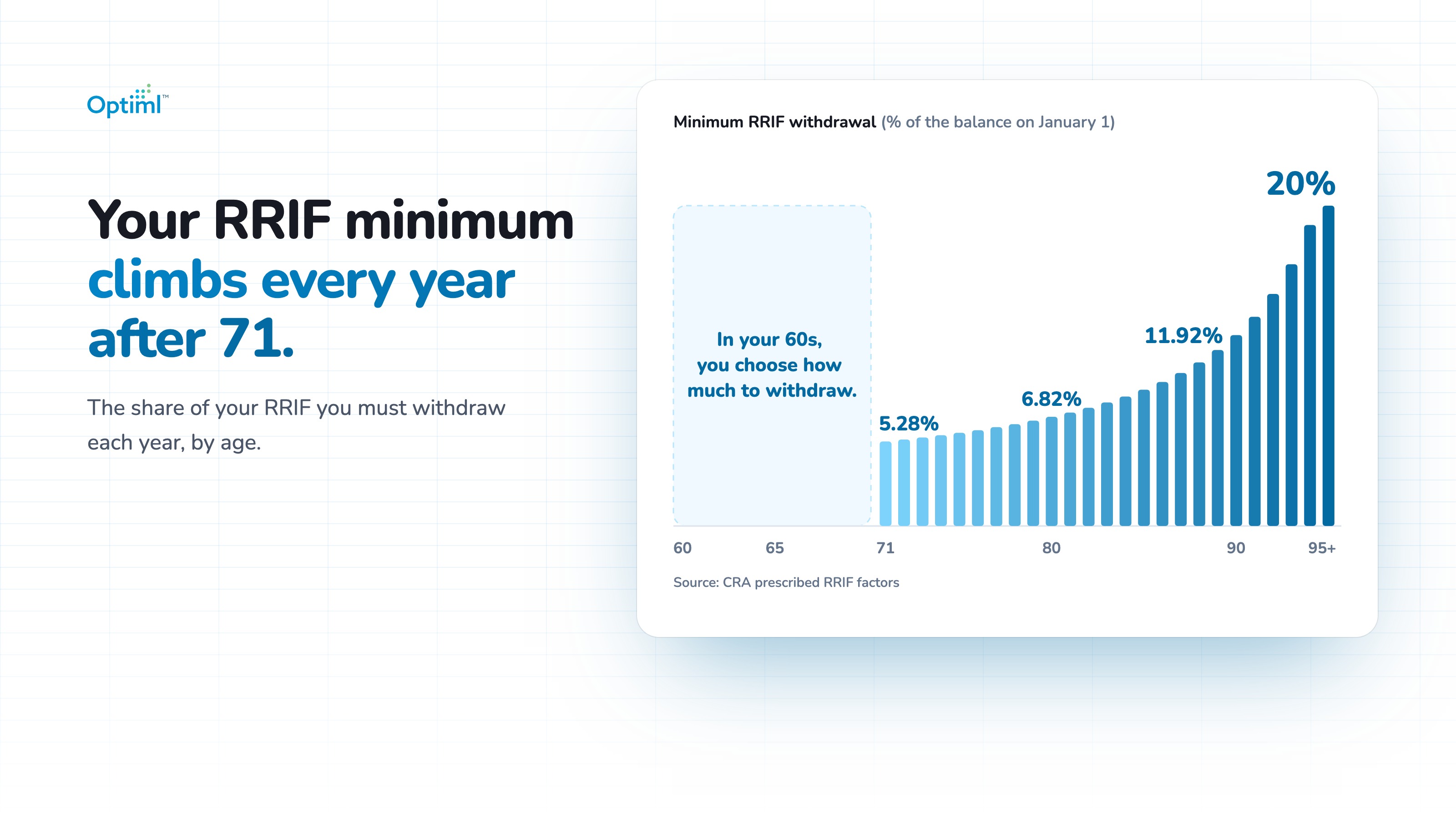
By December 31 of the year you turn 71, your RRSP has to become a RRIF (or buy an annuity). From the following year, you withdraw at least a set percentage of the RRIF's January 1 balance. The percentage climbs every year.
By 71, Diane and Rob's untouched RRSPs have grown to about $1.27 million combined. Their first minimum on that balance is about $66,900.
The rising percentages hide the real pattern. Because the rate climbs as the balance shrinks, the required withdrawal barely moves. It holds at roughly $66,000 a year, every year from 71 to 90. And after two decades of minimums, the RRIF still holds about $550,000 at 90.
That minimum is a floor, not a ceiling. You report it as income whether you need the money or not, for twenty years.
The 60s fix: draw the RRSP down before 71
Those near-empty years at 63 and 64, and the $20,000-a-year stretch that follows, are where the RRSP should start coming out. Each withdrawal fills a low bracket that would otherwise sit empty. Whatever Diane and Rob don't spend moves into their TFSAs to keep growing tax-free.
Why pay tax at 64 on money you don't need yet? Because that money gets taxed eventually. The only question is at what rate. A smaller RRSP at 71 means a smaller minimum at 72, and in every year after.
This is the RRSP Meltdown, and it's built into Optiml as its own strategy. You choose a pace (Conservative aims to empty your registered accounts by 85, Moderate by 82, Aggressive by 78) or set your own start and end ages for each spouse.
On the preset paces, each year's withdrawal is capped at a tax bracket boundary and at the OAS clawback threshold, so the drawdown doesn't push your income further than you intended.
Trap 2: Income stacking pushes you toward the OAS clawback
Those three income steps are the stacking trap. The low brackets in the first step go unused, and the third step carries the load. Every RRIF dollar at 72 sits on top of CPP and OAS, in a higher bracket than it would have faced at 64. And as net income climbs, the federal age amount (a tax credit for anyone 65 and up) shrinks too.
Add a workplace pension or a bigger RRIF, and the stack runs into the OAS clawback. On 2026 income, OAS is reduced by 15 cents for every dollar of net income above $95,323. No single decision triggers it. The layers do. Our full guide to the OAS clawback covers the thresholds and seven ways to manage it.
The 60s fix: time CPP and OAS around the drawdown
CPP grows 0.7% for every month you delay past 65, up to 42% more at 70. OAS grows 0.6% a month, up to 36% more at 70.
Deferring both, and living on RRSP withdrawals in the meantime, does two jobs at once. It moves more of the RRSP out in your lowest-tax years. And it swaps some of the RRIF income you'd be required to take later for larger, inflation-indexed benefits that pay for life.
Deferral isn't a rule. It's a calculation. Your health, your spouse's age, your other income and what a surviving spouse would receive all move the answer. The right age for CPP isn't always the right age for OAS.
Optiml's CPP & OAS Optimizer models every start age, 60 to 70 for CPP and 65 to 70 for OAS, against your full plan, including the RRIF that follows.
Trap 3: Two tax returns become one
For couples, this can be the biggest single tax jump of retirement.
When one spouse outlives the other, the RRIF rolls to the survivor tax-free. That part works well.
But the survivor now reports the entire minimum on one return. One OAS benefit instead of two. CPP capped at a single maximum pension. No one to split income with. Some planners call it the widow's tax.
Picture Rob filing alone at 74, next to the same year with both of them filing.
The household's income fell by about $16,000. The tax bill went up anyway. And Rob is now less than $2,000 below the OAS clawback line, where one capital gain or a bigger withdrawal for a new roof starts the 15% recovery.
The 60s fix: use both sets of brackets while you have them
Every RRIF dollar the two of you draw down together, across two returns and two sets of low brackets, is a dollar a surviving spouse never reports alone. That's one of the strongest arguments for an earlier drawdown, and a single-person projection misses it entirely.
Pension income splitting makes those years work harder. Once the spouse who owns the RRIF is 65, up to 50% of RRIF income can be reported on the other spouse's return, and each of you can claim the pension income credit on up to $2,000. Straight RRSP withdrawals don't qualify. That's the case for converting part of your RRSP to a RRIF at 65 instead of waiting for 71.
Every Optiml plan applies pension income splitting automatically and runs each spouse to their own life expectancy. The survivor years, with the rollover, the CPP survivor benefit and the single return, show up in your projection instead of arriving as a surprise.
Trap 4: The RRIF on your final tax return
When a RRIF can no longer roll to a spouse, whatever is left is reported as income on the final tax return. All of it, in one year.
Diane and Rob's minimum-only path still holds about $550,000 at 90. On one final return, that's roughly $550,000 of income in a single year. In Ontario, more than half of it is taxed in the top bracket, at 53.53%.
The minimum-only path is built to leave a large balance late in life. That's the balance the final return taxes hardest.
The 60s fix: shift the balance into your TFSA over time
The same drawdown in your 60s, with the surplus routed into your TFSA each year (and into a non-registered account once that room is full), moves money out of an account that's fully taxable at the end. TFSA withdrawals don't count toward the OAS clawback either, so that money stays flexible in every year in between.
Optiml's Estate Projector shows what that does to the after-tax value of what you leave behind, with the RRIF's final-return tax already counted. Compare Plans puts your current path next to a meltdown path, so you can see lifetime tax and after-tax estate for both before you commit to either.
The Bottom Line
Every RRIF trap in your 70s comes from the same place. A large registered balance meets a fixed set of rules after 71, with fewer levers left to pull.
Your 60s are different. Low brackets. Two tax returns. Flexible start ages for CPP and OAS. Fresh TFSA room every year. That's where the cheap fixes live. (Already past 71? The levers are fewer, not gone. We ran the age-71 deadline through Optiml.)
Optiml models all four traps in one plan, so you can see your 70s while changing them is still cheap.
Your 70s tax bill gets written in your 60s.
Ready to optimize your retirement plan?
Join thousands of Canadians making smarter financial decisions with Optiml.
Start Free Trial