

Most Canadians picture retirement as a date they get to pick. Work to 65, get the mortgage close to paid off, then start drawing on your savings. It's a sensible plan. It also assumes the paycheque keeps coming until you decide it stops.
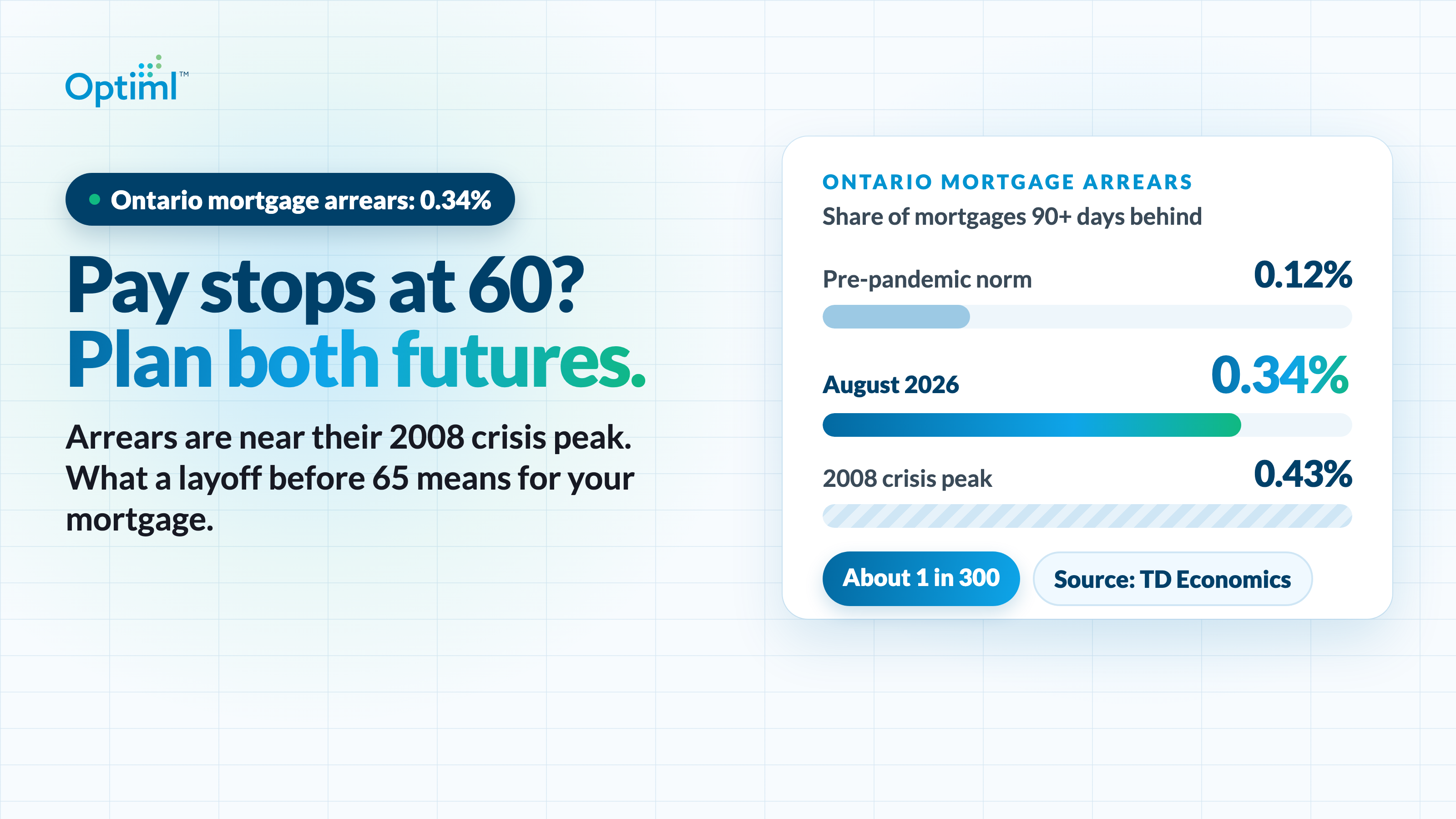
But Ontario's mortgage numbers this fall are a reminder that the paycheque doesn't always wait for you. According to TD Economics, Ontario's mortgage arrears rate reached 0.34% in August, nearly triple its pre-pandemic norm and closing in on its 2008 financial crisis peak.
If you're 55 to 64, I don't read that as a housing story. I read it as a planning question: if your pay stopped at 60 instead of 65, what would your plan do with the mortgage, and what would you change first?
My answer is four levers, in this order: your retirement date, your Canada Pension Plan (CPP) start age, which account covers the payment, and the house itself. Data first, then the math.
What Ontario's Mortgage Arrears Numbers Actually Say
Arrears has a specific meaning. The Canadian Bankers Association (CBA) counts a mortgage as in arrears once payments are 90 days or more behind: three or more months. A single missed mortgage payment doesn't show up in these numbers.
Here's where the rate stands:
- Ontario, August 2026: 0.34%, according to TD Economics. That's nearly triple the province's pre-pandemic norm of 0.12%, and approaching the 0.43% peak recorded during the 2008 global financial crisis.
- Ontario, second quarter of 2026: 0.32%, according to the Canada Mortgage and Housing Corporation (CMHC). CMHC projects Ontario will record the largest and most sustained increase through mid-2027, concentrated in the Greater Toronto and Hamilton Area (GTHA) and Southwestern Ontario.
- Canada, August 2026: 0.30%, according to the CBA, which calls it "still close to historic lows."
Now the perspective, and TD supplies it: "Even at today's elevated rate, roughly one in 300 Ontario mortgages is in arrears." Put the other way, well over 99% of Ontario mortgages aren't. TD titled its report Canadian Consumers: Bending, Not Breaking, and that's the right frame.
Why It's Rising: A Payment Shock Meets an Income Shock
TD points to three causes: large pandemic-era balances relative to income, higher borrowing costs and a weaker labour market. The last two are shocks, and they're landing at the same time.
- The payment shock is the renewal. A mortgage locked in near the 2021 lows can renew at a much higher payment. We worked through that math after the Bank of Canada's October rate hike.
- The income shock is jobs. Ontario's unemployment rate rose 0.3 percentage points to 7.3% in October, according to Statistics Canada. TD notes that's below last year's 7.9% peak but above the province's pre-pandemic trend of around 6%. CMHC ties the regional pattern to areas where "trade tensions are affecting key manufacturing sectors, including the automotive industry." Statistics Canada's October survey shows the strain in the same region: 38.4% of people in Oshawa, 36.9% in Windsor and 35.9% in Hamilton lived in households that found it difficult to meet their financial needs, against 29.7% nationally.
As for timing, TD notes that "mortgage arrears typically lag changes in unemployment by two to three quarters," and expects Ontario's rate to plateau around mid-2027 before gradually declining in the second half of the year.
At 60, a Layoff Can Turn Into a Retirement Date
If you're over 55, the number I'd watch most closely isn't a mortgage number.
Older workers are less likely to be out of work. Statistics Canada put the unemployment rate for Canadians aged 55 and older at 5.5% in October, below the national 6.7%. But when they do lose a job, the search runs longer. The share of unemployed people who had been looking for 27 weeks or more was highest among those 55 and older: 32.7% in October 2026, up from 27.9% a year earlier.
About one in three is still looking after six months.
At 35, a six-month search is a gap between jobs. At 61, with a mortgage still owing, it can become your retirement date. Not the one you planned. The one that arrived.
So I'd plan a layoff in your late 50s or early 60s as two futures, not one:
- The bridge: you're back at work by 62. The gap is two years, and the original plan mostly holds.
- The early retirement: your pay stopped for good at 60. Your plan is now a retirement plan, five years early, with a mortgage still on the house.
You don't need to know which one you're in to plan for both. Run both, and whichever happens, you've already seen the math.
A Walkthrough: Pay Stops at 60 Instead of 65
Imagine you're 60, living in Ontario and planning to work to 65. Here's the household in round numbers. It's an illustration built for this post, not a real person and not an Optiml result.
- Mortgage: $250,000 owing at 4.5%, with 15 years left
- Monthly payment: about $1,907
- Registered Retirement Savings Plan (RRSP): $450,000
- Tax-Free Savings Account (TFSA): $100,000
- CPP: not started
- Old Age Security (OAS): starts at 65 at the earliest
The payment and balances are our arithmetic, compounded semi-annually like a Canadian fixed-rate mortgage, with the rate held at 4.5%. Now the paycheque stops at 60:
Same house, same mortgage, same balance at 65. Either way, you're retiring with a mortgage. What the layoff changes is who pays it for five years: about $114,430 in payments (60 of them, at about $1,907) that your salary used to cover now comes out of your savings, with no OAS yet to help.
Put that next to your accounts. It's more than the entire $100,000 TFSA. From the RRSP, it's about a quarter of the balance, before the tax on every withdrawal. And it's the mortgage alone, before property tax, groceries or anything else.
What if you're back at work by 62? Then it's 24 payments, about $45,772, instead of 60. Two different futures, so build two plans.
What to Change First
Your Retirement Date and Gap-Year Spending
The first change isn't a withdrawal. It's an input. If there's a real chance your pay has stopped for good, move your planned retirement age from 65 to 60 and see what your plan does. Then build the "back at work by 62" version beside it.
Next, look hard at spending from 60 to 65. Every dollar you don't spend in the gap years is a dollar that doesn't have to come out of an account before OAS starts.
Your CPP Start Age
When the pay stops at 60, CPP at 60 looks like the obvious move. It's also permanent. According to Canada.ca, "Payments decrease by 0.6% each month (7.2% per year), up to a maximum reduction of 36% if you start at age 60." Wait past 65 and they rise 0.7% a month, up to 42% at 70.
The age-65 figures are Canada.ca's maximum (January 2026) and average (July 2026); the age-60 column applies the full 36% reduction, our arithmetic. Started at 60, the maximum brings in about $57,894 over the five gap years, roughly half the mortgage payments in our walkthrough. The trade is $542.75 a month less, for life, than starting at 65. And these are upper bounds: five fewer working years can lower the age-65 amount itself.
CPP at 60 can be the right call. So can bridging the gap from savings and letting CPP grow. It's a trade-off, not an automatic move, and the next lever often decides it. We've run the numbers in the CPP math most Canadians never run and in a CPP at 60 vs 70 case study.
Which Account Covers the Mortgage
The years with no paycheque are also your lowest-income years. With a salary, an RRSP withdrawal lands on top of your pay and is taxed at your marginal rate. With no salary, and no CPP or OAS yet, the same withdrawal starts near the bottom of the tax brackets.
Later, the picture fills in: OAS from 65, CPP from whenever you start it, and minimum withdrawals once your RRSP converts to a Registered Retirement Income Fund (RRIF), which happens by the end of the year you turn 71. Each stacks on the others, and higher net income can bring the OAS recovery tax (the clawback) into play.
So the same layoff that squeezes your cash flow can open a low-bracket window. RRSP dollars drawn at 61 can be taxed at lower rates than the same dollars drawn at 72.
That flips a common instinct, which is to spend the tax-free TFSA first and protect the RRSP. In the gap years, the math can point the other way: draw on the RRSP while your income is low, and save the TFSA for later, when a withdrawal adds nothing to your taxable income.
The skill is in the amount: enough to use the low brackets, not so much that you climb right back out. For the related question of where extra savings should go before you retire, see TFSA or mortgage paydown.
Keep, Downsize or Sell the Home
The last lever is usually the biggest asset. If the gap years make the mortgage hard to carry, the house belongs inside the plan, not outside it.
Selling clears the mortgage in one step, and the principal residence exemption generally makes the sale itself tax-free. But renting brings its own costs (see keep the house or sell and rent), and buying smaller doesn't always cost less to carry (see the property tax reset trap).
How to Run Both Versions in Optiml
The arithmetic above is where I'd start. Your own plan is where I'd decide.
Every property in Optiml carries its mortgage balance, interest rate and monthly payment, plus an amortization schedule where you can change the rate year by year and add lump-sum payments. Your retirement age is an input, so "pay stops at 60" is one change, not a rebuild.
Every plan then works out which accounts to draw from, and how much, across your RRSP or RRIF, TFSA and non-registered accounts, toward the strategy you choose, such as Minimize Lifetime Taxes or Maximize After-Tax Estate, with taxes shown year by year and the OAS recovery tax included. Choose the RRSP Meltdown strategy and its preset paces start the drawdown in the year you retire: the window when employment income has stopped and CPP and OAS may not have started yet.
From there:
- The CPP & OAS Optimizer (Pro+ and Legacy) tests your start ages against the rest of your plan, so CPP at 60 is weighed against your RRSP, not decided on its own.
- Your home can be sold in the year you choose, followed by renting, buying a new home or something else.
- Compare Plans (Pro+ and Legacy) puts "work to 65" beside "pay stops at 60," or "back at work by 62," on your own numbers.
- EVA, Optiml's AI assistant, can answer "What if my pay stopped at 60?" and propose the change to your retirement age for you to confirm.
The Bottom Line
Ontario's mortgage arrears are climbing toward their 2008 peak, and TD expects them to plateau around mid-2027. Even so, roughly one in 300 Ontario mortgages is in arrears. Bending, not breaking.
If you're 55 to 64, the useful question isn't whether you'll be the one in 300. It's whether your plan already shows what happens if the paycheque stops five years early. Optiml lets you see both futures before you live either one.
A layoff picks the date. You pick the plan.
Frequently asked questions
What counts as mortgage arrears in Canada?
The Canadian Bankers Association counts a mortgage as in arrears when payments are 90 days or more behind, meaning three or more months. A single missed payment doesn't count. The national rate was 0.30% as of August 2026, still close to historic lows. Ontario's was 0.34% in August, according to TD Economics.
Why are Ontario's mortgage arrears rising?
TD Economics points to large pandemic-era balances relative to income, higher borrowing costs and a weaker labour market; Ontario's unemployment rate was 7.3% in October 2026. CMHC expects the increase to be concentrated in the Greater Toronto and Hamilton Area and Southwestern Ontario, where trade tensions are affecting key manufacturing sectors, including the automotive industry.
When are Ontario's mortgage arrears expected to peak?
TD Economics expects Ontario's arrears rate to plateau around mid-2027, then gradually decline in the second half of the year, because arrears typically lag changes in unemployment by two to three quarters. CMHC also projects Ontario's arrears to rise through mid-2027. Both are forecasts.
Can I take CPP at 60 if I'm laid off?
Yes. You can start CPP as early as 60, laid off or not. Payments drop 0.6% for each month before 65, up to 36% at 60, and the reduction is permanent. On 2026 figures, the maximum is $1,507.65 a month at 65 and about $964.90 at 60. Fewer working years can also lower your base amount.
Should I use my RRSP to pay the mortgage if I lose my job before retirement?
It can make sense. RRSP withdrawals are taxable, but years with no paycheque and no CPP or OAS yet are often your lowest-income years, so withdrawals can be taxed at lower rates than later, when CPP, OAS and RRIF minimums stack up. Draw too much in one year and you climb the brackets, so test the amount on your own plan.
Ready to optimize your retirement plan?
Join thousands of Canadians making smarter financial decisions with Optiml.
Start Free Trial