

Every July, the same quiet reminder lands for Canadians who track this stuff: your Tax-Free Savings Account (TFSA) room is sitting there. The 2026 annual limit is $7,000, the third year running it has held at that level. And if you were 18 or older and a resident since 2009 and have never contributed, your cumulative room as of January 1, 2026 is $109,000. Those are Canada Revenue Agency numbers, not estimates.
So you've got some extra cash. Maybe a bonus, maybe a bit of breathing room in the monthly budget. And the question every pre-retiree asks each summer shows up again: do I put it in the TFSA, or do I throw it at the mortgage?
It sounds like it should have a clean answer. It doesn't. And when you're within a decade of retirement, the decision changes shape.
This isn't a hypothetical. Canadians are genuinely split.
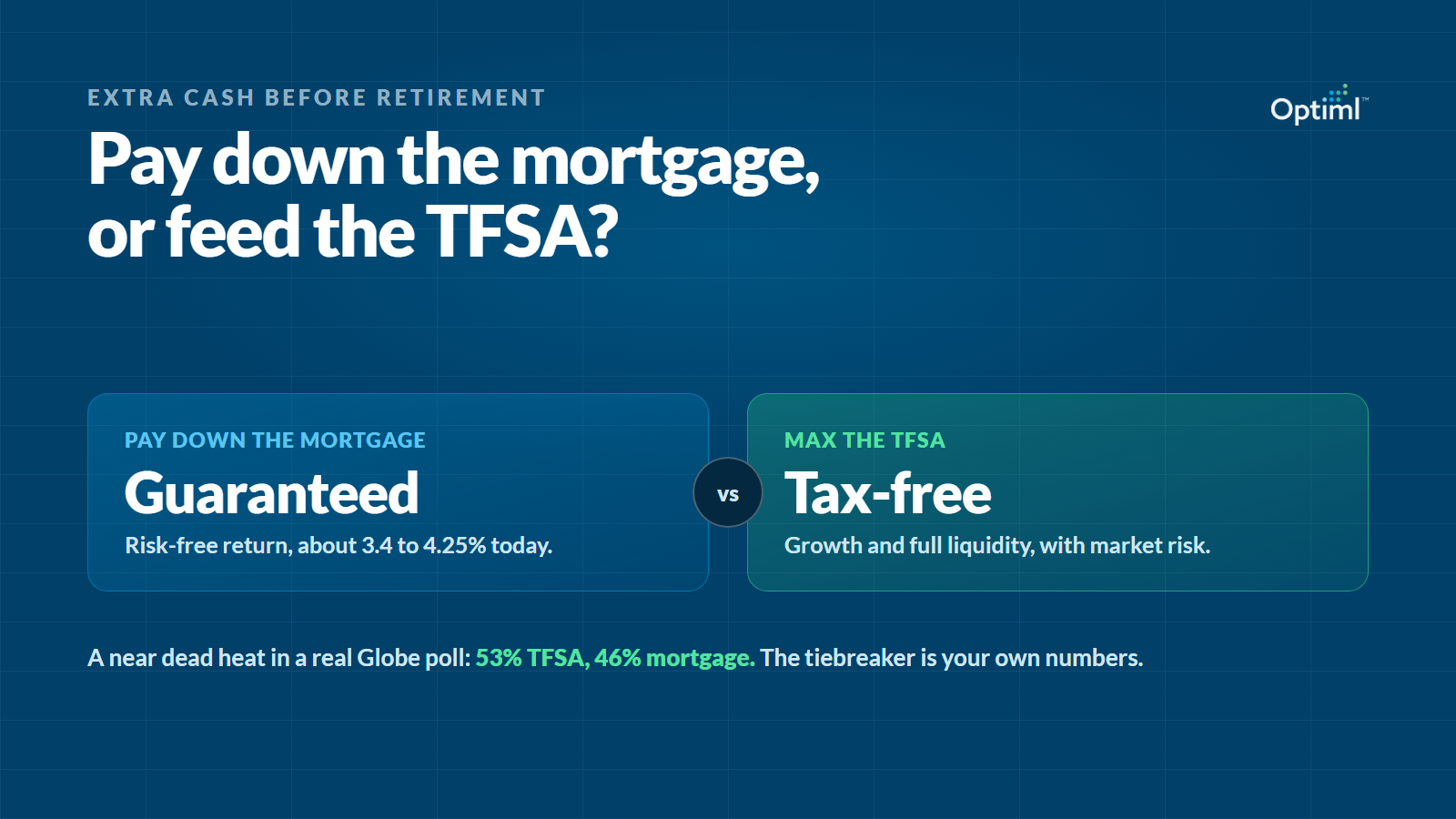
I'm not going to invent a couple to make a point here, because a real one already exists. Rob Carrick ran a reader poll in The Globe and Mail asking what people would do with an extra $15,000. Of 3,505 responses:
- 53% said put it in the TFSA
- 46.2% said pay down the mortgage
- 0.8% said leave it in chequing
That's about as close to a dead heat as a financial question gets. And the comments underneath split along exactly the lines you'd expect.
The pro-TFSA camp made a math argument: invest as long as your expected return beats your mortgage rate, and if you're under 50, investing tends to win because the mortgage gets paid off eventually anyway. The pro-mortgage camp made a certainty argument: there's more certainty in paying down debt than in chasing a market return, and killing the payment frees up cash flow for the rest of your life. Plenty of readers said they'd just split it.
None of them are wrong. They're weighting different things.
The honest framework
Strip away the noise and this is a comparison between two very different kinds of return.
Paying down your mortgage is a guaranteed, risk-free, after-tax return equal to your mortgage rate. Every dollar you put against the principal saves you that rate in interest, with certainty, tax-free. Today the best 5-year fixed rates sit around 3.94% to 4.24%, and the best 5-year variable rates around 3.40% to 3.45%. Those move with bond yields and Bank of Canada decisions (the overnight rate held at 2.25% on July 15, its sixth consecutive hold, with prime at 4.45%). But whatever your rate is, that's your guaranteed return from paying it down.
Your TFSA offers tax-free growth, full liquidity, and no tax on withdrawal, but no guaranteed return. Over a long horizon a diversified portfolio has historically returned more than today's mortgage rates. Over a short one, it might not. It might be down 15% right when you need it.
So on paper, the rule is simple: whichever return is higher on a risk-adjusted basis wins. If your realistic long-run return clears your mortgage rate with room to spare, the TFSA has the edge. If the gap is thin, the guaranteed option looks a lot more attractive.
But "on paper" is doing a lot of work in that sentence. Temperament matters as much as math. There is no universal winner here, and anyone who tells you there is hasn't looked at enough real situations.
What tips it when you're retiring within 10 years
A 35-year-old and a 58-year-old can run the same numbers and land in different places, correctly. Here's what actually moves the needle when retirement is close.
Your mortgage rate versus your realistic long-run return. Not the return you hope for. The one you'd actually plan around. If your rate is 4% and you're planning on a 5% to 6% return, that spread is real but thin, and thin spreads get eaten by sequence risk when your horizon is short.
A shorter horizon narrows the case for volatility. The "invest and you'll come out ahead" argument leans on time. Decades let a market recovery play out. Ten years is enough time for a bad stretch to still be a bad stretch when you hit your retirement date.
Whether you want to carry a mortgage payment against fixed retirement income. A mortgage payment is a fixed obligation. In your working years you cover it from a paycheque. In retirement you cover it from your portfolio, which means drawing more income every year just to service debt. For a lot of people, walking into retirement with no payment is worth more than the spread they'd theoretically capture by investing.
The OAS clawback mechanic, which quietly favours both. This is the one most people miss. In 2026, Old Age Security (OAS) gets reduced by 15 cents for every dollar of net income above $95,323. Here's the key detail: TFSA withdrawals do not count toward that net income figure. Registered Retirement Savings Plan (RRSP) and Registered Retirement Income Fund (RRIF) withdrawals do. So does salary, so do dividends, so do capital gains. A paid-off home lowers the income you need to draw in the first place, and TFSA withdrawals let you top up your spending without adding a dollar to the number the clawback is measured against. Both moves help you stay under the line. (I've written before about why losing some OAS isn't always the disaster it sounds like, but keeping more of it is still a real lever.)
Your actual risk tolerance, honestly assessed. The "TFSA wins on paper" case assumes you stay invested through a downturn. If you're the kind of person who would sell in a panic when your balance drops 20%, that entire case evaporates, because you'd lock in the loss and never capture the recovery the math depended on. Be honest with yourself here. It's the single most important input, and it's the one no calculator can see.
Stop debating it in the abstract. Model both.
Here's the thing about this decision: it's a perfect either/or. Two clear paths, same starting dollars, measurably different outcomes. That's exactly the kind of question you should never settle with a rule of thumb when you can settle it with your own numbers.
In Optiml, you can build "pay down the mortgage" and "max the TFSA" as two separate scenarios and put them side by side with Compare Plans. You'll see the modelled difference in net worth, after-tax estate, and year-by-year retirement cash flow, all the way through your plan. You can watch what each path does to the income you're forced to draw, and whether it keeps you under the OAS clawback threshold. And your Success Score stress-tests each version across hundreds of market scenarios, so the "what if the market's down when I retire" worry stops being a feeling and becomes a number you can actually see.
That's the whole point. You're not guessing which reader in the comments section you agree with. You're running your rate, your balance, your retirement date, and your risk tolerance, and letting the math tell you.
The Bottom Line
The Globe poll landed at 53 to 46 for a reason. This is a genuinely close call, and it stays close because the right answer depends on numbers only you have: your mortgage rate, your realistic return, how many years until you retire, and whether you'd actually hold through a downturn.
Both options are good. A paid-off home lowers what you need. A funded TFSA gives you tax-free, clawback-friendly flexibility. The mistake isn't picking the "wrong" one. The mistake is picking either one blind.
So don't take a side. Run both, for your numbers, and let the plan pick.
Ready to optimize your retirement plan?
Join thousands of Canadians making smarter financial decisions with Optiml.
Start Free Trial