

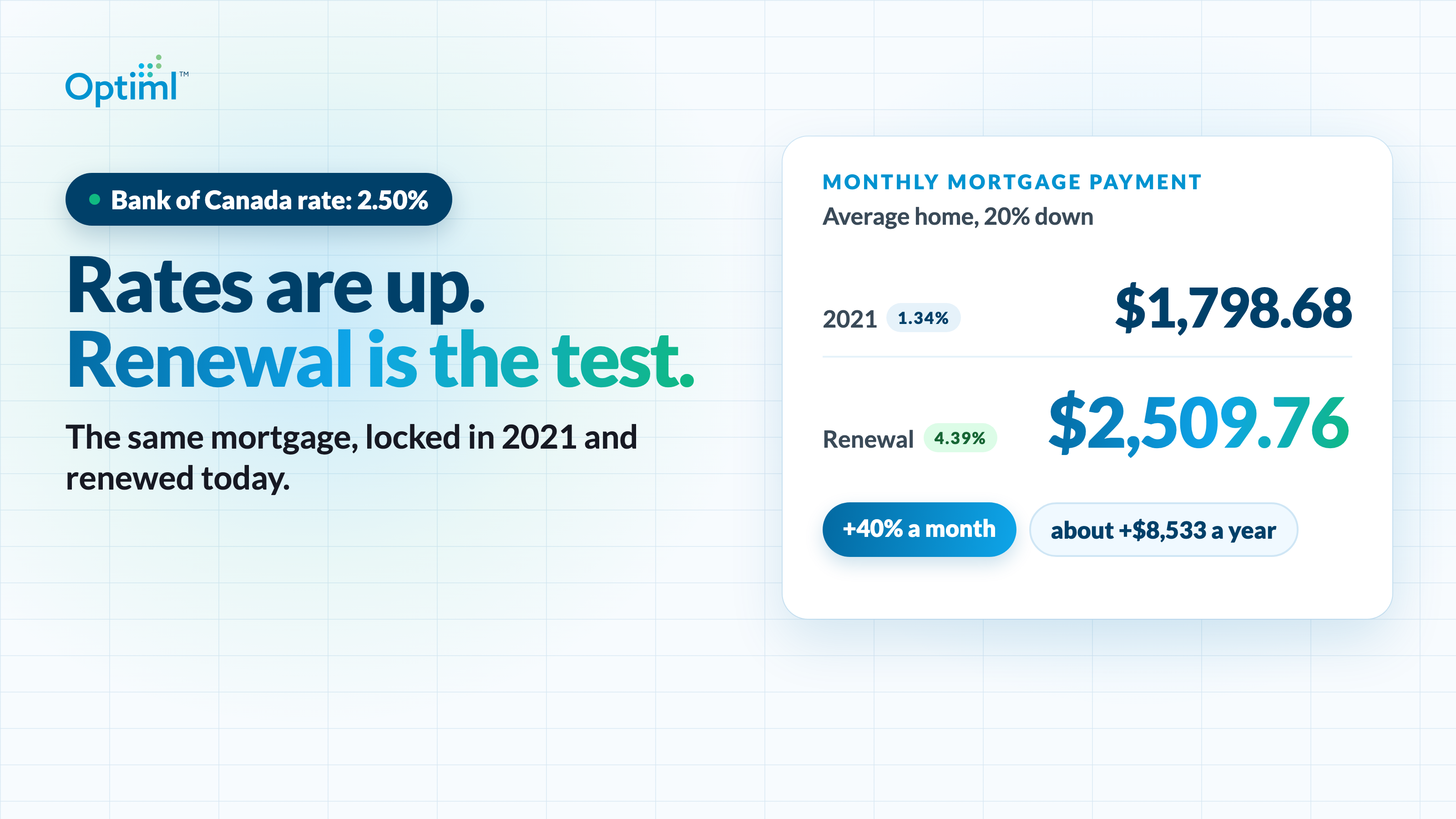
On October 28, 2026, the Bank of Canada raised its target for the overnight rate by a quarter point, from 2.25% to 2.50%. It's the first increase since July 2023, after a long run of decisions at 2.25%.
What it means for you depends on your mortgage. Variable-rate mortgages and home equity lines of credit (HELOCs) follow prime, so they feel it first. Fixed-rate mortgages don't change until renewal. And for most households, the renewal is where the real cost sits.
A rate hike headline makes it sound like every mortgage in the country just got more expensive. It didn't. The number that matters is the gap between the rate you locked in and the rate you renew at. If you're 45 to 65, so does the account that pays for it.
What the Bank of Canada Did on October 28
The hike follows the run of holds we covered in The Bank of Canada Held at 2.25% for a 7th Time. According to the Bank's press release, it puts the Bank Rate at 2.75% and the deposit rate at 2.45%. The Bank gave two reasons:
- Inflation has been higher and more persistent than expected. The Bank says Consumer Price Index (CPI) inflation has been around 3% since April and is expected to rise to about 3.5% by the end of the year.
- Energy prices. The Bank wants to reduce the risk that continuing high energy prices spread broadly to the prices of other goods and services.
Statistics Canada's September CPI shows the energy effect clearly: prices rose 3.1% year over year, with gasoline up 27.8%. Excluding gasoline, CPI rose 2.2%.
On what comes next, the Bank wrote: "There could be a need to increase the policy rate further, but given uncertainties, Governing Council agreed to proceed carefully." The next decision is December 9, 2026. It's the first increase since the Bank's July 2023 hike, as its policy rate history shows.
Who Feels It, and When
- Variable rates and HELOCs follow prime, which banks typically move within a day or two of a Bank of Canada decision.
- Fixed rates follow the 5-year Government of Canada bond yield, not the overnight rate, and they had already moved. On October 28, the lowest 5-year fixed rates were 25 to 30 basis points higher than 30 days earlier, according to WOWA.
- Renewals are where most households meet higher rates. The Bank of Canada's 2025 Financial Stability Report estimated that about 60% of all outstanding mortgages in Canada would renew in 2025 or 2026. And the Canada Mortgage and Housing Corporation's (CMHC) Residential Mortgage Industry Report, published the day before the hike, put it this way: "The largest renewal shock has likely passed, but renewal risk has not disappeared." It singles out borrowers renewing 5-year mortgages taken out in 2021.
- Savers sit on the other side. Higher policy rates also lift rates on guaranteed investment certificates (GICs) and high-interest savings accounts.
My Take: Don't Panic Over a Quarter Point
Here's the hike itself, in dollars. On a $500,000 mortgage with 25 years left, going from 4.39% to 4.64% adds about $70 a month, or about $834 a year. On $300,000, it's about $42 a month.
Worth knowing. Not worth losing sleep over. Next to a renewal, a quarter point is small, and the renewal is where your attention belongs.
What 30 Years of Interest Costs on the Average Canadian Home
The Canadian Real Estate Association (CREA) put the non-seasonally adjusted national average home price at $666,538 in September 2026. It's a national average skewed by Toronto and Vancouver, so your local number may look very different.
Put 20% down ($133,308) and you borrow $533,230. With 20% or more down, your lender sets the maximum amortization (with less than 20% down, it's 25 years, or 30 for first-time buyers and new builds, per the Financial Consumer Agency of Canada). We use 30 years here. Here's that mortgage at the 2021 low and at today's rate:
The 2021 rate is the insured 5-year fixed rate nesto advertised in 2021. Today's rate is the lowest 5-year fixed rate for buyers with 20% or more down, per WOWA on October 28, 2026. The payments are our arithmetic, compounded semi-annually like a Canadian fixed-rate mortgage, with each rate held for all 30 years. Real mortgages renew along the way, so read this as what a rate is worth, not a forecast.
At today's rate, the same home costs $855.92 more a month than at the 2021 low, and about $308,000 more in interest over 30 years. That's about 3.7 times the interest, on the exact same house.
A 25-year amortization shrinks both numbers without changing the story: $94,313 of interest at 1.34% and $342,398 at 4.39%.
The Renewal Is the Real Event
Most people 45 to 65 aren't buying today. They're renewing, and the group CMHC singles out locked in 5-year fixed rates in 2021.
Imagine you borrowed that same $533,230 at 1.34% in 2021, over 30 years. When your 5-year term ends, you owe about $458,509. Here's your payment if you renew over the remaining 25 years:
At today's rate, that's $711.08 more a month, about $8,533 a year, on a smaller balance than you started with. That's the number I'd plan around, not the quarter point.
The good news: it's a known number, arriving on a known date. That makes it plannable.
If You're 45 to 65, Ask Which Account Pays
Retired, or close? Then a higher payment comes out of your withdrawals, and withdrawals from a Registered Retirement Savings Plan (RRSP) or Registered Retirement Income Fund (RRIF) are taxable. It takes more than a dollar of withdrawal to cover a dollar of payment.
Our arithmetic, as an example: at a 30% marginal tax rate, covering that extra $8,533 a year takes about $12,190 of RRIF withdrawals. The added taxable income can also push your net income toward the Old Age Security (OAS) recovery tax threshold, which is $95,323 on 2026 income.
Fund the same $8,533 from a Tax-Free Savings Account (TFSA) or a non-registered account and the tax cost is different. Same payment, different bill.
Pay It Off Before You Retire?
Writing in The Globe and Mail on October 19, Rob Carrick argued for paying off your mortgage years before you retire, because retirees have less room than workers to absorb higher costs with raises. He cites the 2026 Fidelity Retirement Report: 22% of retirees surveyed had a mortgage, and just 46% of them expected to have it paid off in less than 10 years.
Tracy Valko, a mortgage broker quoted by Money.ca, put the counterpoint simply: "It doesn't have to be an either-or decision. It starts with cash flow."
My view: both make a fair point, and both skip a step. The question isn't "pay it off or not" in the abstract. It's three questions:
- Which account pays? RRSP and RRIF dollars are taxed on the way out. TFSA dollars aren't.
- What does it do to your taxes and OAS? Paying off the mortgage by drawing down an RRSP can create its own tax bill, and a big jump in net income can bring the OAS recovery tax into play.
- How much liquidity is left? A paid-off house with no cash cushion trades one risk for another.
We've worked through versions of this before: TFSA or mortgage paydown when you're retiring within a decade, EVA's answer on paying off the mortgage or investing, and why a mortgage is the only leverage I'd use.
Test Your Renewal Rate in Optiml
A headline tells you what the Bank did. Your plan tells you what it does to you.
Every property in Optiml carries its mortgage balance, mortgage interest rate and monthly payment, plus an amortization schedule where you can set the interest rate year by year and add lump-sum payments. Model a higher rate from your renewal year on, and Optiml carries it through your cash flow, your withdrawals and your taxes. You see what a renewal rate does to your whole retirement, OAS clawback included.
Then put two futures side by side. Compare Plans (Pro+ and Legacy) sets a "renew at 4.4%" plan beside a "renew at 5.5%" plan, on your own numbers. Or ask EVA, Optiml's AI assistant: "What if my mortgage renews at 5.5%?"
The Bottom Line
The Bank of Canada's first hike since 2023 is worth tens of dollars a month on a typical mortgage. A renewal can be worth hundreds, and for anyone who locked in near the 2021 lows, a payment about 40% higher.
Higher rates cut both ways: they cost borrowers more and pay savers more. Close to retirement, the move isn't to react to the headline. It's to put your renewal rate into your plan and see which account pays, what happens to your taxes and OAS, and how much cushion you keep. Optiml lets you do that before the renewal letter arrives.
The quarter point is the headline. Your renewal is the plan.
Frequently asked questions
Did the Bank of Canada raise interest rates in October 2026?
Yes. On October 28, 2026, the Bank of Canada raised its target for the overnight rate by 25 basis points, from 2.25% to 2.50%. It's the first increase since July 2023. The Bank said there could be a need to increase the rate further but that it agreed to proceed carefully. The next decision is December 9, 2026.
How does the Bank of Canada rate hike affect my mortgage?
It depends on your mortgage type. Variable-rate mortgages and HELOCs follow prime, which banks typically move within a day or two of a Bank of Canada decision. Fixed rates follow the 5-year Government of Canada bond yield, and a fixed payment doesn't change until renewal. On a $500,000 balance with 25 years left, a quarter point adds about $70 a month.
How much will my mortgage payment go up at renewal?
In our example, $533,230 borrowed at 1.34% in 2021 over 30 years leaves about $458,509 owing after five years. Renewing for the remaining 25 years at 4.39% raises the payment from $1,798.68 to $2,509.76 a month, about 40% more. At 5.25%, it rises to $2,732.34, about 52% more.
How much interest will I pay on a mortgage for the average Canadian home?
With the September 2026 national average home price of $666,538 and 20% down, the mortgage is $533,230. Over a 30-year amortization, our arithmetic puts total interest at $114,295 at 2021's 1.34% and $422,426 at today's 4.39%, with each rate held for the full 30 years.
Should I pay off my mortgage before I retire?
Being mortgage-free in retirement has real advantages, but how you get there matters. RRSP and RRIF withdrawals are taxable, so clearing a mortgage with them can create its own tax bill and push your net income toward the OAS recovery tax threshold. Keep a cash buffer, compare which account pays, and test both paths on your own plan.
Ready to optimize your retirement plan?
Join thousands of Canadians making smarter financial decisions with Optiml.
Start Free Trial