

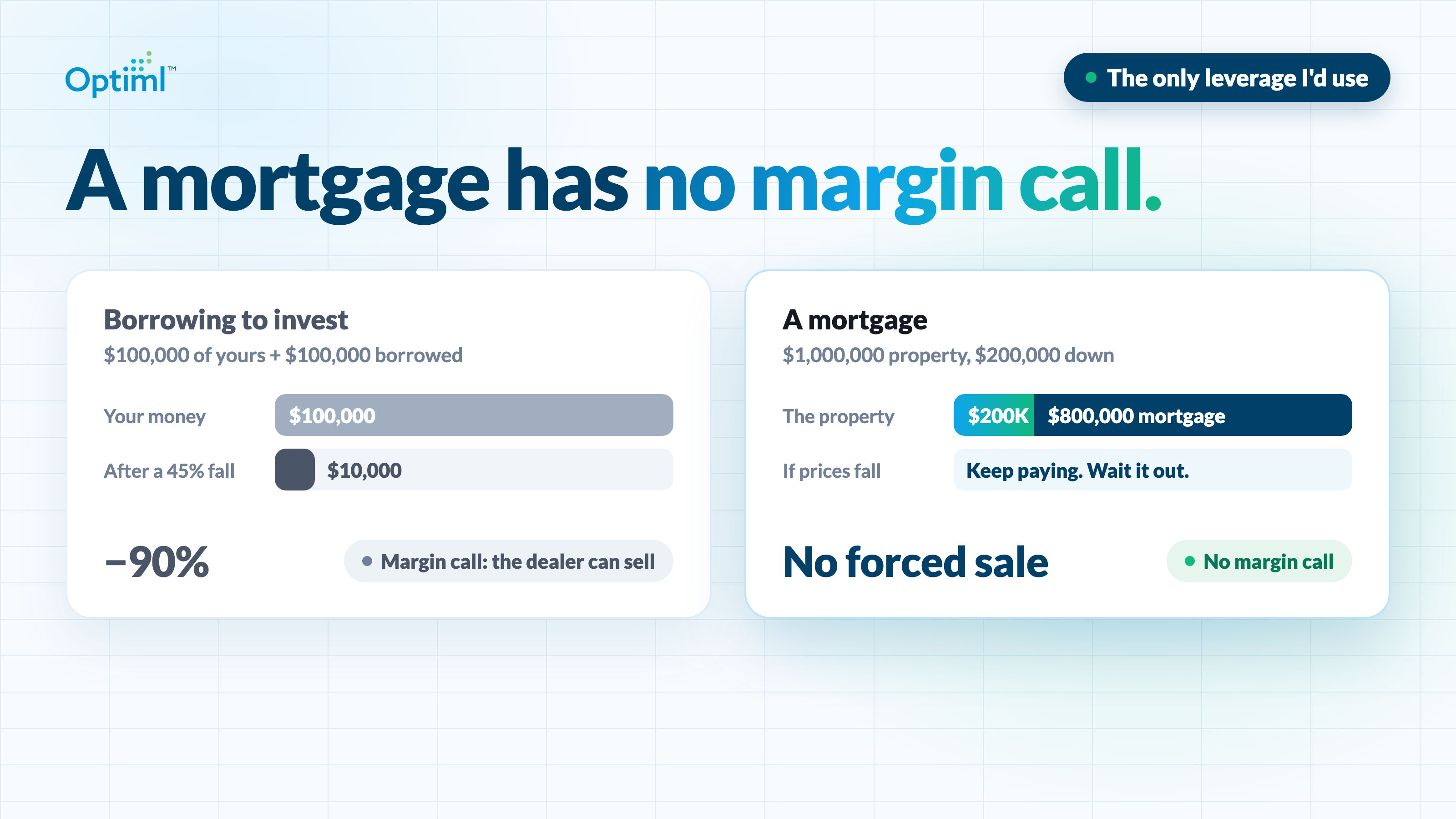
Borrowing to invest is easy to like. Borrow at 5%, earn 8%, keep the difference. On a spreadsheet, it looks like free money.
But the loan doesn't care what your investment did.
I think borrowing to invest in the stock market carries a risk the spreadsheet hides. If the investment falls, you still owe the full loan. If it goes to zero, you're stuck holding the bag and paying interest on something that's gone.
I'm not against leverage. I'm against leverage on an asset that can go to zero, from a lender who can sell you out when prices fall. The only kind of leverage I'd use myself is on an asset that always keeps a value, with a loan that doesn't force a sale when prices drop. You may already have it.
When the Investment Falls, the Loan Doesn't
Start with a single company. Say you borrow $100,000 and buy its shares. If the company does well, great. If it goes poof, your shares are worth nothing and you still owe $100,000, plus interest, until it's paid off.
A broad, diversified index fund is a different animal. For it to reach zero, every company in it would have to fail. But it can fall hard, and fast. According to a 2010 Statistics Canada analysis, the Toronto Stock Exchange peaked in June 2008 and then fell rapidly until early March 2009, a 45% drop. Sixty-one percent of that drop came in just two months, October and November 2008.
Now put borrowed money under a fall like that. Simple arithmetic, round numbers:
- You invest $100,000 of your own and borrow $100,000. Your portfolio is $200,000.
- The market falls 45%. Your portfolio is now $110,000.
- You still owe $100,000. What's left of your own money: $10,000.
A 45% drop in the market became a 90% drop in your money. Borrow a little more than half and the same fall takes all of it. Either way, the interest on the $100,000 keeps coming.
The Margin Call Makes It Permanent
If that loan sits in a margin account, waiting isn't always your call. When a margin account's value falls below the required level, the dealer issues a margin call. If you don't meet it, the dealer can sell your holdings without your approval. Questrade and Wealthsimple both explain this in their own guides. The Canadian Investment Regulatory Organization (CIRO) sets the minimum margin requirements, and dealers can set stricter ones.
Think about when that sale happens. Falling prices trigger it, so it lands near the bottom. The loss stops being a number on a statement and becomes real, and whatever recovery comes next happens without you.
The Only Kind of Leverage I'd Use
So which asset can't go to zero?
What is it, you ask? Impossible, you say...
Real estate.
When you buy a home or an income property with a mortgage on it, guess what: that's leveraged investing. You're borrowing money to buy an asset, betting its value grows by more than you pay in interest.
Here's a simple illustration with round numbers. You buy a $1,000,000 property with $200,000 down and an $800,000 mortgage. If it grows 3-5% a year, that's $30,000-$50,000 a year. On the $200,000 you actually put in, that's a 15-25% return.
That's before interest and carrying costs, and they're real. At an assumed 4-5% rate, interest on $800,000 runs about $32,000-$40,000 a year in the early years. Same ballpark as the growth.
So where does the return come from? That depends on which property it is, and the two work differently:
- Your home: the offset is the rent you no longer pay. You have to live somewhere, and rent is gone the day you pay it. The growth, and every dollar of principal you pay down, stays yours.
- An income property: the rent has to cover the interest, property taxes, insurance and operating costs. If it does, the growth on the full $1,000,000 builds on your $200,000. If it covers the principal too, your tenants are paying down your mortgage. If it falls short, you top it up every month.
There are lots of expenses either way. But one thing I know for sure: that property isn't going to zero. There can be bad years where the value doesn't grow, or even drops. What you can bet on is that it will still have a value.
A company can go poof. People always need a place to live.
Leverage Cuts Both Ways, Even on a House
The property keeps a value. Your equity is a different story. Leverage magnifies a drop on your equity the same way it magnifies a gain.
Same $1,000,000 property, $200,000 down. Simple illustration, round numbers, before interest, carrying costs and principal paydown:
A 10% drop erases half your equity. A 20% drop erases all of it on paper, with the full $800,000 still owed.
Drops like these have happened here. In Fort McMurray, the average sale price in October 2015 was $468,199, down about $117,000, or 20%, from a year earlier, based on Canadian Real Estate Association (CREA) data reported by HuffPost Canada in November 2015. In Toronto, the Toronto Real Estate Board's home price index fell 8.9% from May to December 2017, the largest seven-month decline in data going back to 2000, as Canadian Mortgage Professional reported on January 8, 2018.
Look at what those numbers say, though. Fort McMurray homes still sold for an average of $468,199. A painful drop. Not zero.
A Mortgage Has No Margin Call
This is the real difference between the two kinds of leverage, and it's structural.
If your home's value falls 20%, your lender doesn't ask you to top up your down payment. Nobody sells your house without your approval because the one down the street sold for less. As long as you keep making the payments, a price drop doesn't force you to sell. You get to wait out the bad years. In a margin account, the dealer can make that call for you, at the worst possible time.
Waiting isn't free, though, and Toronto condos show the cost this year. The Toronto Regional Real Estate Board (TRREB) MLS Home Price Index benchmark for apartments was $535,200 in July 2026, down 7.35% year over year, according to TRREB data reported by Canadian Mortgage Professional on August 6, 2026.
No one is forcing those owners to sell, and the condos still have a value. But an investor whose rent doesn't cover the interest, condo fees, property taxes and insurance is paying every month to wait. That's my "paying the interest" point, applied to real estate. It's the reason to run your numbers before you buy, not after.
What Changes as Retirement Gets Closer
If you're between 45 and 65 and weighing an income property with a mortgage against a loan to invest in the market, the gap between them widens every year.
- An income property produces cash flow. Rent arrives every month and grows on its own track. It's taxable, net of expenses, but it's income you can plan around.
- A market loan mostly doesn't. Beyond dividends, the only way to get money out is to sell, and the loan carries the risk that someone sells for you.
- The runway shrinks. At 45, a bad year has decades to recover. At 62, it has far fewer, and a forced sale near the bottom lands right where your withdrawals begin. That's where "no margin call" matters most.
Carrying a mortgage into retirement raises its own question. The payment becomes a retirement expense, funded by withdrawals like everything else.
Withdrawals from a Registered Retirement Savings Plan (RRSP) or Registered Retirement Income Fund (RRIF) are taxable income. So a $2,000 monthly payment funded from your RRIF takes more than $2,000 a month in pre-tax withdrawals to cover. That extra income raises your taxable income, and if it pushes your net income high enough, it can bring the Old Age Security (OAS) recovery tax into play.
The payment also resets at every renewal. In a July 2025 Staff Analytical Note, the Bank of Canada expected about 60% of mortgage holders renewing in 2025 and 2026 to see a payment increase: about 10% on average for 2025 renewals and about 6% for 2026 renewals, compared with December 2024, and roughly 15-20% for five-year fixed holders. Variable-rate, variable-payment holders were expected to see declines of roughly 5-7%.
None of that makes a mortgage in retirement a mistake. It makes the payment something to model: spending with pre-tax dollars behind it, at a rate that can change.
How I'd Run the Numbers in Optiml
This is what I'd do before signing anything. Optiml's Real Estate section covers a Primary Residence, Recreation Property, Income Property and Land. For each property, you enter:
- The property: Current value, Purchase price and Growth rate.
- The mortgage: Mortgage balance, Mortgage interest rate and Monthly mortgage payment, with an Amortization schedule where you can change the interest rate year by year. Set a higher rate from your renewal year on and you'll see what a renewal does to the whole plan.
- The costs: Annual operating expenses, Annual insurance and Annual property taxes.
- The rent, on an income property: Gross rental income, with its own growth rate.
Haven't bought yet? Add an Income Property Goal with the purchase price, the Down payment amount, the year you plan to buy, the mortgage and the rent you expect. Or ask EVA, "What if I purchased an income property?" Then put the plan with the property and the plan without it side by side in Compare Plans, and look at Net Worth over time in each.
Then build the bad case yourself. Lower the income property's Growth rate to 0% and run it again. If the plan still works in a flat market, with the rent covering the costs and the payments funded, that's leverage I'd be comfortable with. If it only works at 5% growth, it's a bet.
The same plan answers the retirement question. The mortgage payment sits inside your spending, and Optiml works out which accounts fund it each year, along with the tax on each withdrawal. If you want any of it explained in plain language, ask EVA, the AI assistant available on every plan.
Income properties and Compare Plans are part of Pro+ and Legacy, and both plans come with a 14-day free trial.
The Bottom Line
Leverage magnifies whatever happens to the asset underneath it, up or down. That's true of a stock portfolio, and it's true of a house.
The difference is what happens next. A loan to invest can leave you holding the debt and paying the interest after the investment falls, and a margin call can sell you out near the bottom. A mortgage sits on an asset that keeps a value, and as long as you keep paying, nobody forces the sale.
That's the only kind of leverage I'd use myself. And I'd still run the numbers first.
For me, the right debt is the kind that lets you wait.
Ready to optimize your retirement plan?
Join thousands of Canadians making smarter financial decisions with Optiml.
Start Free Trial