

A donation receipt feels like paperwork. You give, the receipt arrives, and in April it goes on whichever return gets done first.
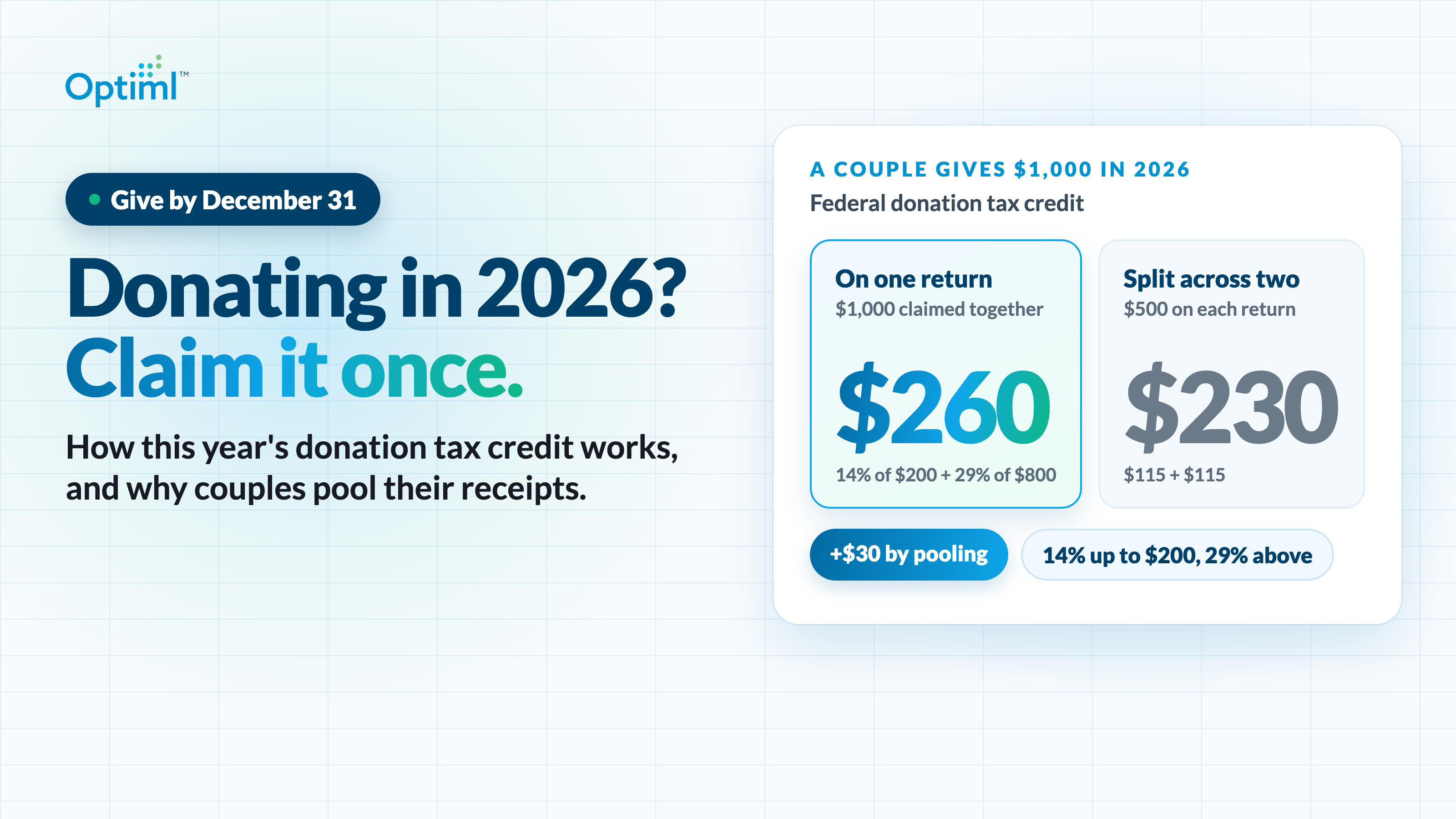
But the charitable donation tax credit for 2026 isn't one flat rate. Federally, your first $200 of donations earns 14% and everything above it earns 29%. That line at $200 is why a couple who claims all their gifts on one return gets more back than a couple who splits them. Same gifts. Same charities. A bigger credit.
If you're planning charitable donations before December 31, here's how this year's credit works, what counts for 2026, and why a couple only wants to cross that $200 line once.
How the donation tax credit works in Canada for 2026
The federal credit has two tiers, plus a higher rate at the top of the income scale.
- 14% on the first $200 of donations.
- 29% on the amount above $200.
- 33% on the part above $200, but only to the extent your taxable income is over $258,482.
That first rate has moved. It was a blended 14.5% for 2025 and 15% before that. Some online calculators still show 15%, which is out of date for 2026. TaxTips' 2026 donation credit rates list the current numbers for every province.
Every province adds its own credit on top. Each sets its own rates, so the examples in this post use federal figures only. Two provinces are worth flagging. Alberta credits 60% on the first $200 and 21% on the amount above. Quebec has its own credit, claimed on the Quebec return.
You claim donations on line 34900 of your return, and the Canada Revenue Agency (CRA) calls the credit "a non-refundable tax credit." That word, non-refundable, comes back later.
Why couples should claim donations on one return
Start with who can claim. The CRA's guidance on who can claim donations is direct. "You or your spouse or common law partner may be able to claim..." Either spouse can claim the couple's donations.
That choice matters because every return that claims donations starts at the bottom tier. Split your gifts across two returns and two $200 bands get the 14% rate. Put them on one return and only one does. The other $200 moves up to 29%.
Imagine a couple giving $1,000 in 2026. Neither has taxable income over $258,482, so the 33% rate doesn't come into it.
- All on one return. 14% × $200 = $28, plus 29% × $800 = $232. That's $260 in federal credits.
- Split $500 each. Each return gets 14% × $200 = $28, plus 29% × $300 = $87, or $115 each. That's $230 together.
Pooling is worth $30 more. What if they give $2,500 instead? Here's the federal math at both sizes (illustrative, federal credit only).
The gap doesn't grow. It's $30 at $1,000 and $30 at $2,500, because it comes from one $200 band and nothing else. Pool your gifts and that band earns 29% instead of 14%. Fifteen points on $200 is $30. The benefit is about that one band, not the size of your gifts.
Thirty dollars isn't a windfall. But it's free, it's there every year you give, and the provincial side usually adds to it, because provincial credits work the same two-tier way.
Alberta is the exception. Its credit is 60% on the first $200 and 21% above, so the first $200 is the more valuable band there. A second $200 band adds $78 to an Alberta couple's provincial credit, more than the $30 that pooling adds federally. In Alberta, a couple comes out ahead when the other spouse claims $200 and the rest goes on one return.
If you already use pension income splitting, notice the contrast. Splitting moves income between returns to even them out. Donations go the other way. Federally, you gain by stacking them on one.
And if one of you has taxable income over $258,482, part of the amount above $200 earns 33% on that return instead of 29%.
Charitable donations before December 31: what counts for 2026
The timing rule is short. The CRA's guide P113, Gifts and Income Tax, says "The donation date is the date that the gift is made." To count on your 2026 return, a gift has to be made by December 31, 2026. Make it in January and it's a 2027 gift.
You'll also need an official donation receipt from a registered charity or other qualified donee. Keep both spouses' receipts together so whoever claims has every one.
Giving is one item on a longer December list. We covered the rest in the year-end financial moves to review before January.
What the credit can and can't do
It can take your tax to zero, not below
A non-refundable credit can reduce your tax to zero, but it won't produce a refund on its own. It only helps if you have tax to pay. So pool your gifts on a return with enough tax to use the full credit.
It's capped at 75% of net income
The CRA's page on how much you can claim sets the limit at "75% of your net income (line 23600)." On a few hundred or a few thousand dollars of gifts, that only matters if the claiming spouse's net income is very low.
Anything you don't claim isn't lost. The CRA lets you "carry forward amounts... for any of the next 5 years."
It doesn't reduce your OAS clawback
The credit lowers the tax you owe. It doesn't lower your net income. The Old Age Security (OAS) recovery tax, better known as the OAS clawback, is based on net income, so giving doesn't reduce it.
That's not a reason to give less. It means the clawback needs its own plan, and we laid out how the OAS clawback works in 2026 and the legitimate ways to reduce it.
See what your giving costs across retirement
If you give every year, your giving belongs in your retirement budget, the same as travel or a new car. And what it really costs you is the after-tax amount.
In Optiml, giving goes into your plan as a Charity goal. It can be one-time or recurring, with planned amounts by year and an end year. It also asks, "Will this donation be eligible for a tax credit?" When it is, Optiml calculates the federal and provincial donation credits in each year's taxes in your plan.
- Couples are covered. Donations are claimed on the higher-income spouse's return. In Alberta, the other spouse also claims the first $200.
- The limit is built in. The 75% of net income limit is applied.
- You can see it year by year. Each year's tax breakdown shows the donations claimed and the Charitable Donations Credit, federal and provincial.
That turns "what's my receipt worth this April?" into a better question. What does our giving cost across the whole retirement, and does the rest of the plan still work?
The Bottom Line
For 2026, the federal donation credit is 14% on your first $200 and 29% above it. Gifts made by December 31 count for this year. And since either spouse can claim the household's donations, putting them on one return means crossing the $200 line once instead of twice.
On $1,000 of gifts, that's $260 federally instead of $230, from exactly the same generosity.
Same gifts. One return. More back.
Frequently asked questions
What is the charitable donation tax credit for 2026?
Federally, it's 14% on the first $200 of donations and 29% on the amount above $200. A 33% rate applies to the part above $200 only to the extent your taxable income is over $258,482. Every province adds its own credit on top, and Quebec's is claimed on the Quebec return.
Do charitable donations have to be made by December 31?
Yes, to count for 2026. The CRA says "The donation date is the date that the gift is made," so a gift has to be made by December 31, 2026 to be claimed on your 2026 return. You'll need an official donation receipt from a registered charity or other qualified donee.
Can my spouse claim my donations?
Yes. The CRA says "You or your spouse or common law partner may be able to claim..." so either spouse can claim the couple's donations. Claiming them on one return means only one $200 band gets the 14% federal rate. On $1,000 of gifts, that's $260 in federal credits on one return versus $230 split evenly.
Do charitable donations reduce the OAS clawback?
No. The donation credit lowers the tax you owe, not your net income. The OAS recovery tax is based on net income, so giving doesn't reduce it.
What if I can't use the whole credit this year?
The credit is non-refundable, so it can reduce your tax to zero but won't produce a refund on its own. Your claim is also limited to 75% of your net income (line 23600). Amounts you don't claim aren't lost. The CRA lets you "carry forward amounts... for any of the next 5 years."
Ready to optimize your retirement plan?
Join thousands of Canadians making smarter financial decisions with Optiml.
Start Free Trial