

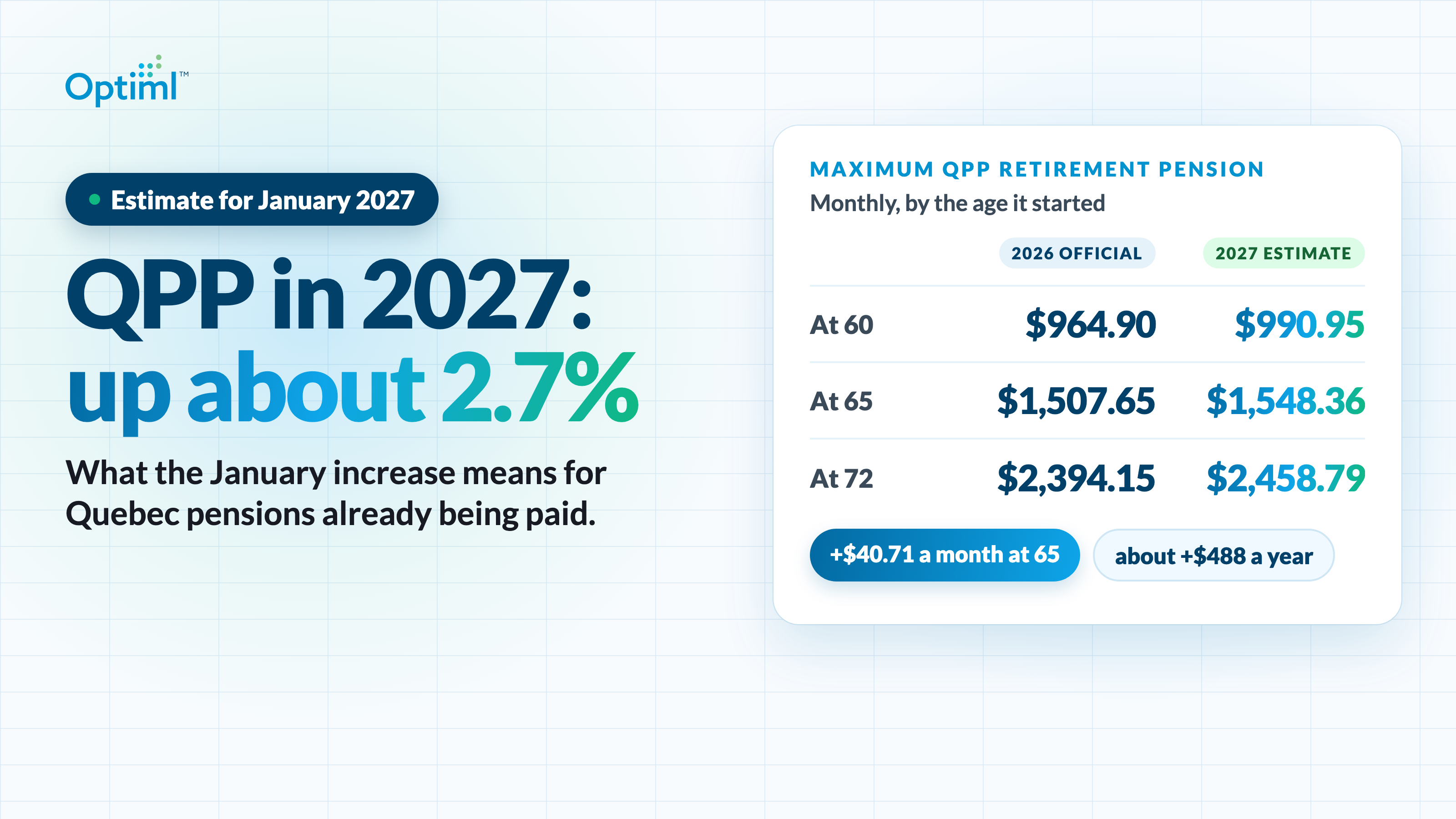
Quebec Pension Plan (QPP) payments are expected to rise by about 2.7% in January 2027 for people already receiving them. At that rate, the maximum retirement pension at 65 would go from $1,507.65 a month to about $1,548.36, an increase of $40.71 a month.
Retraite Québec, which administers the QPP, hasn't announced the 2027 indexation rate yet. The 2.7% figure is the published estimate for the Canada Pension Plan (CPP), from Jason Yee, principal financial analyst at Finepoint Solutions Inc., as reported by The Globe and Mail on October 23, 2026. There's no separate estimate for the QPP.
But the QPP is indexed with the same formula and the same price index as the CPP, so the two rates should match. They did in January 2026, when both plans rose 2.0%.
Until the official rate is published, treat every 2027 number on this page as an estimate. We'll update this page as soon as Retraite Québec announces it.
Receiving the CPP instead? We cover every CPP benefit, with its own 2027 estimates, in CPP Increase 2027.
Maximum QPP in 2027: the 2026 amounts and the 2.7% estimate
Here's what a 2.7% increase looks like on Retraite Québec's official 2026 maximums.
The 2026 figures are the monthly maximums published by Retraite Québec. The 2027 column is our arithmetic at 2.7%, rounded to the cent, for pensions already being paid. The death benefit is a single payment and isn't indexed.
Over a full year, the maximum at 65 rises by about $488. The maximum pension started at 72 rises by about $776.
Small amounts, but they build. Each January's increase is applied to the amount after the previous one, for as long as the pension is paid.
How the QPP indexation rate is calculated
Retraite Québec indexes pensions in payment once a year, every January. The rate is the percentage change in the average Consumer Price Index (CPI) for Canada over the 12 months from November to October, compared with the average for the previous 12 months.
It's the same national index the CPP uses, which is why the two plans move together.
Here's how that formula produced the January 2026 increase:
- November 2023 to October 2024: average CPI of 160.4
- November 2024 to October 2025: average CPI of 163.6
- Change: about 2.0% (163.6 ÷ 160.4), applied to QPP pensions in January 2026
For January 2027, the average for November 2025 to October 2026 is compared with 163.6. A 2.7% increase needs that average to reach about 168.0 (163.6 × 1.027).
Because the formula uses a 12-month average, a single month of high or low inflation moves the result only a little. And it only works in one direction. If the average falls, pension amounts stay the same. QPP pensions never go down.
Past QPP indexation rates
Here's the January increase for each of the last six years.
A 2.7% increase would match January 2022. It would be well below the 6.5% of 2023 and a little above the 2.0% of 2026.
When the official 2027 QPP rate is announced
October's CPI, released by Statistics Canada in mid-November, is the last month in the calculation. Retraite Québec announced the 2026 rate on November 26, 2025, so the official number usually arrives in late November. The increase then applies from your January 2027 payment.
Who gets the QPP increase in January 2027
The January increase applies to pensions already being paid. If you receive a QPP retirement, disability or surviving spouse's pension now, it's automatic. There's nothing to apply for.
Starting your pension in 2027 works differently. The maximum for a new pension depends on the 2027 earnings limits, and it hasn't been published yet. So $1,548.36 isn't the maximum for a pension that starts in 2027. It's what someone already receiving the 2026 maximum at 65 would be paid.
Your start age matters far more than one year of indexation. In 2026, the maximum pension starting at 60 is $964.90 a month. Starting at 72, it's $2,394.15.
Indexation then applies to whatever amount you lock in. At 2.7%, the maximum started at 72 gets $64.64 more a month, while the maximum started at 60 gets $26.05. Same rate, larger base, larger raise, every January.
We walk through the start-age trade-off in When to take CPP: 60, 65 or 70. The same logic applies to the QPP, with two more years to wait in Quebec.
What's different from the CPP
The QPP and the CPP share the same indexation formula. In 2026 they also share the same maximum at 65, $1,507.65 a month, after the same 2.0% increase in January. The differences are in when you can start and how much each month of waiting is worth.
- Latest start age: the QPP can start as late as 72. The CPP stops at 70.
- Starting after 65: both plans add 0.7% for each month you wait. The QPP reaches up to 58.8% more at 72 and stops increasing after that. The CPP reaches 42% more at 70.
- Starting before 65: the QPP reduction is 0.5% to 0.6% a month, depending on the size of your pension, so 30% to 36% lower at 60. The CPP uses a flat 0.6% a month, or 36% lower at 60.
- Disability and survivor pensions: the amounts differ between the two plans. The figures on this page are QPP figures. For the CPP amounts, see our CPP increase 2027 post.
OAS adjusts four times a year
Old Age Security (OAS) is a federal benefit, paid in Quebec as in the rest of Canada. It also runs on a different schedule. OAS amounts are reviewed four times a year, in January, April, July and October, rather than once. Your QPP adjusts every January; your OAS can change in smaller steps through the year.
What the January increase means for your plan
One January raise of a few dozen dollars won't change your retirement. Two decisions matter more: when you start your QPP, and how that income stacks with your Registered Retirement Savings Plan (RRSP) or Registered Retirement Income Fund (RRIF) withdrawals and your OAS.
Optiml models those together. For a Quebec plan, it uses QPP rules: a start age anywhere from 60 to 72, the QPP's own reduction for starting early, and the 0.7% monthly increase after 65, up to 58.8% at 72.
You can enter your own expected pension at 65, or, if you already receive it, your current amount and the date it started. From there, your QPP and OAS grow each year with your plan's inflation assumption. Both are fully taxable income in the plan, with Quebec and federal tax modelled.
Once your plan is run, Optiml can optimize your QPP and OAS start ages for the whole plan, taxes included, with the CPP & OAS Optimizer. So the age you choose reflects every year of income and tax, not one January increase.
The Bottom Line
QPP pensions are expected to rise about 2.7% in January 2027, in line with the published CPP estimate. That would take the maximum at 65 from $1,507.65 to about $1,548.36 a month for people already receiving it. October's CPI completes the calculation, and Retraite Québec usually confirms the rate in late November.
The increase is automatic. The larger decisions are yours: when to start your QPP, anywhere from 60 to 72, and how it fits with your RRSP or RRIF withdrawals and your OAS.
Optiml models those decisions together, across every year of your plan.
Retraite Québec sets the rate. You choose the start age.
Frequently asked questions
Will QPP payments increase in January 2027?
They're expected to. Retraite Québec hasn't announced the 2027 indexation rate yet. The only published estimate is for the CPP: about 2.7% for January 2027, from Jason Yee, principal financial analyst at Finepoint Solutions Inc., as reported by The Globe and Mail on October 23, 2026. The QPP uses the same formula and the same index as the CPP, so the two rates should match, as they did in January 2026, when both rose 2.0%.
What is the maximum QPP payment in 2027?
For someone already receiving the 2026 maximum at 65 of $1,507.65 a month, a 2.7% increase would mean about $1,548.36 a month in 2027, roughly $488 more a year. For a pension started at 72, the 2026 maximum of $2,394.15 would become about $2,458.79. The maximum for a pension that starts in 2027 hasn't been published yet. It depends on the 2027 earnings limits.
How is the QPP indexation rate calculated?
Retraite Québec indexes pensions in payment every January. The rate is the percentage change in the average Consumer Price Index for Canada over the 12 months from November to October, compared with the previous 12 months. For January 2026, the average rose from 160.4 to 163.6, an increase of about 2.0%. If the average falls, pension amounts stay the same. They never go down.
When will Retraite Québec announce the 2027 QPP indexation rate?
October's CPI, released by Statistics Canada in mid-November, is the last month in the calculation. Retraite Québec announced the 2026 rate on November 26, 2025, so the official 2027 rate usually arrives in late November. The increase applies from the January 2027 payment.
When is the QPP payment in January 2027?
Retraite Québec publishes the payment calendar. The indexed amount shows up with your January 2027 payment.
Is the QPP increase the same as the CPP increase?
It should be. Both plans use the same indexation formula and Canada's Consumer Price Index, and both rose 2.0% in January 2026. The maximum pension at 65 was also the same in both plans in 2026: $1,507.65 a month. The plans differ on start ages. The QPP can start as late as 72, with up to 58.8% more, while the CPP stops at 70, with 42% more. Disability and survivor amounts also differ between the two plans.
Ready to optimize your retirement plan?
Join thousands of Canadians making smarter financial decisions with Optiml.
Start Free Trial