

Optiml turned two last week. I have written about that already, and this is not that post.
This one is about what we actually built in year two, what two years of watching people use it taught us, and what we are building next. I went back through every update we shipped since last September to write this, and the shape of the list was not what I expected.
191 updates, and only 44 of them were new features
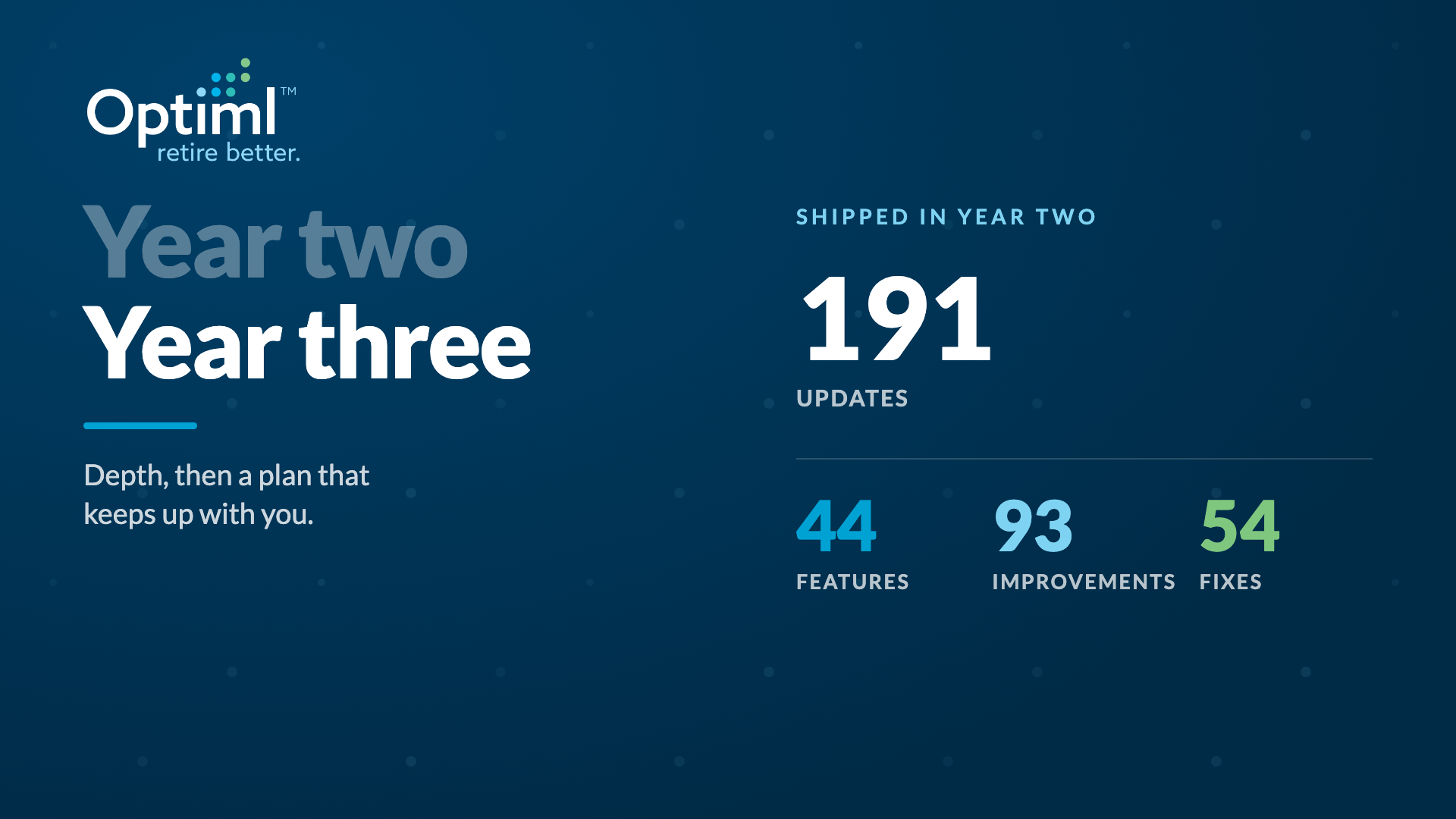
Between September 2025 and now we shipped 191 updates to Optiml. Forty-four new features, ninety-three improvements, fifty-four fixes.
The count is not the interesting part. The ratio is. For every new thing we added, we spent roughly three more making something that already existed work better. When we launched, I assumed year two would be about adding. It turned out to be about going deeper into what was already there.
That was not a strategy we wrote down. It is what happens when you listen to people who are using the thing for real.
What "deeper" actually meant
Your situation stopped having to be simple
In year one, a lot of people had to round their life off to fit the model. If your situation did not look like the common case, you approximated, and an approximation at the input stage undermines everything downstream.
So most of year two went into removing those compromises. Separate RRSP (Registered Retirement Savings Plan) and RRIF (Registered Retirement Income Fund) accounts rather than one blended balance. Multiple LIRA (Locked-In Retirement Account) and LIF (Life Income Fund) accounts, because people who changed jobs a few times do not have exactly one. Annuities. CPP (Canada Pension Plan) survivor and disability benefits. RDSP (Registered Disability Savings Plan). Defined contribution pensions with your own accrual rates. Rental property income, and rental losses. Business expenses inside a holding company, and charitable giving paid through one. Life insurance with its cash surrender value counted properly.
None of those is a headline. Together they are the difference between a plan that is roughly about you and a plan that is actually about you.
The strategies became things you choose
In April we shipped the named strategies: RRSP Meltdown, OAS Clawback and Minimize Lifetime Taxes, alongside Set Estate Value working at the level of individual assets. In September we went back and let you keep your own RRSP to RRIF conversion ages and your own CPP (Canada Pension Plan) and OAS (Old Age Security) start ages while still running a preset meltdown.
That second update matters more than the first. Giving someone a strategy is easy. Letting them keep the parts of their own plan they had already thought hard about, while the strategy handles the rest, is the harder and more useful version.
The math got more precise, in public
This is the unglamorous part, and it was a lot of year two.
Quebec pension income splitting before age 65, which is treated differently provincially than federally. A British Columbia tax update. GIS (Guaranteed Income Supplement) first-year proration. Stricter spousal income attribution. More accurate RRIF and LIF minimum withdrawals. A detailed tax breakdown and a detailed capital gains breakdown, so that instead of trusting a number you can open it and see how it was built.
Nobody writes in asking for a provincial tax correction. It is also precisely the work that decides whether your plan is right, and we would rather be the kind of company that spends a quarter on it.
It got faster, and it learned to check itself
Plan calculations got faster. CPP and OAS optimization got faster. The interest model was rebuilt for speed and stability.
And in August we shipped the AI Input Validator. Before you run a plan, it reads your inputs and looks for the extra zero, the field that contradicts another field, the thing that would quietly pull your whole projection away from reality. It takes about a minute and it catches the kind of mistake that is invisible until it has already skewed thirty years of output.
That one is worth pausing on, because it is the first thing we built that works on your behalf without being asked. It is also the clearest signal of where year three goes.
What two years of this taught us
Here is the thing I did not fully understand when we launched.
A retirement plan is not a document. It is a living thing, and almost nobody has the time to keep it alive.
People build a genuinely good plan. Then life moves. They change jobs, sell a property, get an inheritance, retire a year earlier than they meant to, or simply watch their accounts drift somewhere different from where the plan assumed. The plan does not become wrong all at once. It goes stale slowly, and usually nobody notices until a decision is already made.
That is not a software problem in the usual sense. The software is right. Keeping it current is work, and life is busy, and the plan sits there waiting to be opened.
Year three is built around that.
Year three
EVA 2.0
EVA started as a way to ask questions about your plan and get answers grounded in your own numbers. Useful, and nowhere near the whole opportunity.
The next version does the work rather than describing it.
Tell EVA you sold the rental property, or that your salary changed, or that you have decided to retire two years earlier than planned, and EVA makes the change in your plan and re-runs it. No hunting for the right screen, no remembering which page a particular field lives on. You say what happened, and your plan catches up.
Scenarios work the same way. Instead of building a second version by hand to compare against your first, you describe the version you are curious about and EVA builds it for you.
And it will not be limited to two. Compare Plans today puts two versions side by side, which is a real improvement on guessing, but it still makes you narrow the field down yourself before you begin. EVA 2.0 will let you put several strategies up at once. The question moves from "is this one better than that one" to "out of all the sensible options, which actually fits my life".
The ambition is straightforward. Most of what currently requires you to know your way around Optiml should be something you can simply ask for.
A plan that keeps up with you
Today Optiml can already connect to your real accounts, so your balances are not a number you typed in once and forgot. That is the first piece of a much bigger idea.
Where we are heading is a plan that notices. One that sees something has moved, re-runs itself, and tells you what changed and whether it matters, rather than waiting for you to wonder. Most of the time the answer will be that nothing meaningful has changed and you can get on with your day. That is a feature, not a disappointment. The value is in not having to check.
Alongside that, two things that sound smaller and are not. Proper guidance while you build, because year two proved that the people who get the most out of Optiml are the ones who understand what the model is doing, and that should not depend on how much time you are willing to spend learning it. And Optiml getting in touch when something in your plan genuinely needs your attention, rather than sitting quietly until you happen to log in.
Advisors
We also launched Optiml for Advisors, which lets an advisor build and model in Optiml and then share the plan with their client, so both people are looking at the same math instead of a PDF and a conversation. It is early, it is growing quickly, and it is going to get a lot of attention this year.
It is the same engine and the same mission reaching a different kind of user, and the feedback from advisors is already changing what we build for everybody.
What I am actually looking forward to
Two years in, the thing I keep coming back to is how much of this has been shaped by people telling us what was missing. Most of what I listed above exists because someone wrote in.
What I want for year three is for Optiml to ask less of you. Not a simpler plan, the plans should keep getting more sophisticated, but less work to keep an accurate one in front of you. Fewer screens to learn. Less remembering to come back. More of the software doing the part that is genuinely tedious, so the part that is genuinely yours, deciding what you want your retirement to look like, is where your attention goes.
We are nowhere near done. That is the best part.
Ready to optimize your retirement plan?
Join thousands of Canadians making smarter financial decisions with Optiml.
Start Free Trial