

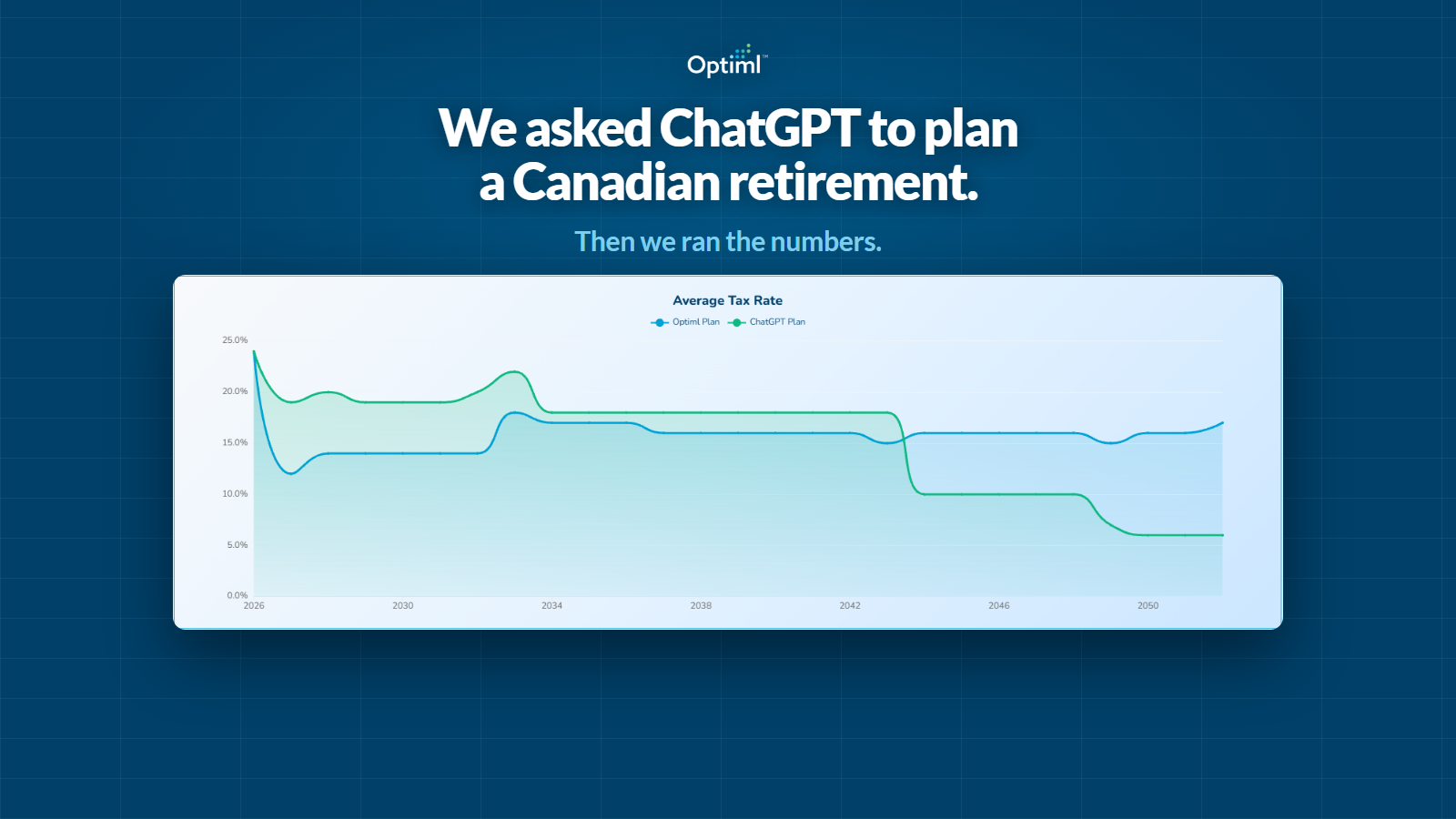
Ask an AI chatbot to plan your retirement and you will get an answer. A confident one, in seconds, with a withdrawal order, a benefit start age, and a projected estate at the end of it. That is a genuinely useful thing, and it did not exist three years ago.
So in July 2026 we ran a real test. We gave ChatGPT, running GPT-5.5, a complete Canadian retirement scenario and asked it to build a drawdown plan. Then we took its exact plan, entered it into Optiml, and modelled it properly, year by year.
What came back failed in three separate layers, and the layers get worse as you go down. It knew the right words. It did not know the strategy. And then it could not calculate what its own plan would do.
The single most surprising result: its plan pays $43,816 less tax than Optiml's plan and still finishes $86,736 poorer. That result is worth understanding whether or not you have ever opened an AI chatbot.
The scenario we gave it
We kept it clean and realistic, the kind of profile we see constantly:
- 62 years old, retiring next year at 63
- Single, living in Nova Scotia
- RRSP (Registered Retirement Savings Plan): $780,000
- TFSA (Tax-Free Savings Account): $95,000
- Non-registered: $120,000
- No workplace pension
- Target spending: $65,000 after tax per year
The question was simple. What withdrawal order, and should CPP (Canada Pension Plan) start at 65 or 70?
It stated its own assumptions clearly, which we appreciated: 5% return, 2% inflation, spending indexed at 2%, retire at 63, model to age 90, CPP at 65 estimated at $15,000 per year, and OAS (Old Age Security) around $9,000 per year. Those are reasonable. We used the identical ones in Optiml so the comparison would be fair.
Layer one: it knew the vocabulary
Credit where it is due, and then we move on.
It rejected the standard advice to spend non-registered money first, which is the default recommendation across most retirement articles and frequently the wrong one. It named the RRSP meltdown: drawing the RRSP down deliberately in the low-income window before mandatory RRIF (Registered Retirement Income Fund) minimums begin, rather than letting the balance compound into a larger forced-withdrawal problem later. It said preserve the TFSA. It said defer CPP given no defined benefit pension.
Those are the right concepts. We write about most of them ourselves, including the meltdown strategy.
On the aggregate outputs it could estimate, it also did well. Lifetime spending matched Optiml one to one. Its lifetime tax estimate of $320,000 to $390,000 contained the real answer of $389,078. And its benefit timing was close: it said CPP at 70 and OAS at 65, while Optiml's optimum was both at 69, a difference worth only 4.6% of after-tax estate.
But here is the thing about all of that. It knew the vocabulary of good decumulation. Knowing the vocabulary is not the same as producing a good plan.
Layer two: it did not know the strategy
This is the heart of it.
Its plan and Optiml's plan had broadly similar annual withdrawal totals. The person is spending the same money in both. The entire difference is which accounts the money comes from each year, and that difference cost about 30% of the estate.
It thinks in phases. Real optimization happens every year.
ChatGPT drew from one account at a time, in blocks. RRSP only from 63 to 69. Then RRIF plus CPP and OAS from 70 onward. TFSA untouched until forced.
Optiml draws from multiple accounts every single year, adjusting the blend to hold taxable income in the right band. In this plan, that meant roughly 60% RRSP and 40% non-registered for the first six years, then later roughly 80% RRIF and 20% TFSA drawn at the same time.
Blending is not a refinement on top of the strategy. It is the strategy. A phase-based plan can only pick an account. A year-based plan picks a taxable income number and then works out which combination of accounts delivers the spending while landing on it.
Saving the TFSA for last is the mistake
This one is nearly universal, and it is worth unlearning.
The TFSA is not a prize you protect until the end. It is the tool you reach for in the specific years your marginal rate would otherwise spike, because TFSA withdrawals are not taxable income. That makes it the only account that can fund spending without moving your tax bracket at all.
Optiml used it tactically, alongside the RRIF, in the years where it did the most work. ChatGPT protected it, and then had no choice but to make large withdrawals late, at exactly the point where the flexibility was worth the least.
It actually went further than protecting the TFSA. It fed it, deliberately, with money pulled out of the RRSP early. That decision turns out to explain almost the entire result, and we come back to it below.
It drew the registered accounts down too fast, and emptied them at 80
Many people assume that if a meltdown is good, a faster meltdown is better. Here it was not.
ChatGPT's schedule fully depleted the RRSP and RRIF by age 80. Once the registered balance is gone, you have lost your only real lever for managing taxable income. There is nothing left to shift, blend, or time. The plan stops being a plan and becomes a spend-down of whatever remains.
The tax-rate curve is the proof
We compared average tax rate year by year for both plans. Ignore the first year, 2026, which is a working year of salary at about 24% for both. After that the two plans separate completely.
Optiml held a tight band: roughly 12% to 18%, every year, for the whole retirement.
ChatGPT swung from 6% to 22%. It sat at 19% to 22% through the early and middle years, then collapsed to about 10% around 2044, and to roughly 6% for the final years.
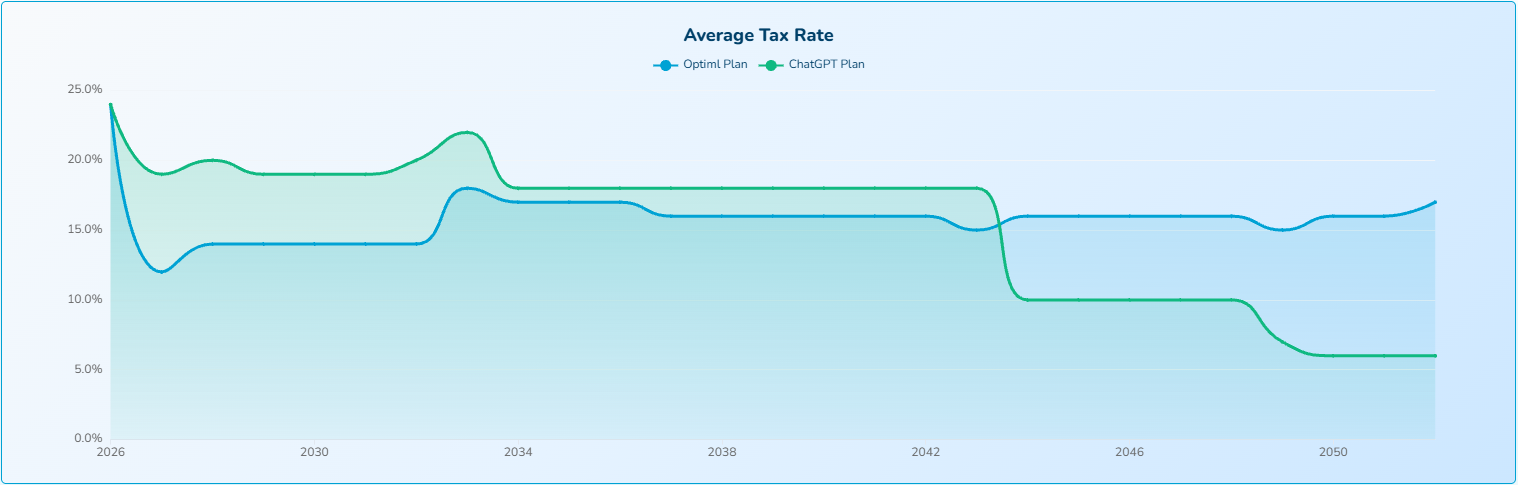
Average tax rate by year: Optiml's plan versus ChatGPT's plan. The green line's collapse at age 80 is the moment its registered accounts run dry.
2044 is age 80. That collapse is not efficiency. It is the depletion signature.
The registered accounts are empty, so there is almost no taxable income left to report. Those very low tax years at the end are not a benefit the plan earned. They are the evidence of the failure.
And this is the general principle, the one that matters whether your plan came from a chatbot, a spreadsheet, or a rule of thumb you read once:
Both ends of that swing cost you money.
The 22% years overpay, because that money could have come out of the same accounts in a different year at a lower rate. The 6% years waste low-bracket room that never comes back, because unused low brackets do not carry forward. You cannot bank an empty bracket and spend it later. Every year you spend below your efficient band is a year of cheap withdrawal capacity thrown away permanently.
Smoothing the band is not a nice-to-have on top of the optimization. Smoothing the band is the optimization. It is also why a partial RRSP-to-RRIF conversion before 71 is worth modelling, and why the OAS clawback is a band problem rather than a threshold problem: the recovery threshold sits at $95,323 for the 2026 income year, and a plan that swings wildly will cross it in some years for no reason.
Layer three: and then the arithmetic was wrong
This is a separate failure, and it is worth keeping it separate.
Layer two is its plan performs worse than Optiml's plan. Layer three is it could not predict what its own plan would do. Those are different problems, and the second one is arguably more consequential, because it means you cannot check the first one by asking.
ChatGPT projected that its own plan would leave an after-tax estate of $800,000 to $900,000 at age 90.
We took its exact withdrawal schedule, dollar for dollar, year by year, and entered it into Optiml using Custom Plan overrides, which let you set any deposit and any withdrawal in any account in any year and model the result. Same starting balances. Same 5% return. Same 2% inflation. Same spending.
The real after-tax estate of its plan: $231,092.
Roughly a four times overestimate, produced using its own plan and its own assumptions. Someone acting on that number would be planning around roughly $600,000 that is not there.
It missed on the intermediate figures too. It predicted its own RRSP would sit at $600,000 to $650,000 at age 70. The real figure for its own plan is $529,079. Same direction, same cause.
The mechanism: "grow then subtract" versus "withdraw then grow"
You can reverse engineer the shortcut. The starting portfolio is $995,000. Compound that at 5% for 27 years and you get roughly $3.7 million. Subtract about $2.3 million of lifetime spending and you land inside its predicted pre-tax range of $950,000 to $1.15 million.
That is the error. It grew the whole starting portfolio for 27 years and then subtracted lifetime spending at the end, instead of withdrawing each year and compounding only what was left.
Those two methods sound like they should produce similar answers. They do not. Every dollar you withdraw in year one is a dollar that never compounds for the remaining 26 years. Grow first and subtract later, and you have quietly credited yourself with 27 years of return on money you spent in your sixties.
Modelled properly, Optiml's optimized plan produces a pre-tax estate of $343,287. The gap between "grow then subtract" and "withdraw then grow" is roughly $700,000 over 27 years.
Check any spreadsheet or calculator you rely on for this. If it applies a growth rate to a starting balance and nets off spending at the end, it is making the same error, and the error grows with your time horizon.
Three more we could verify
The CPP deferral math. It wrote that a $15,000 CPP benefit at 65 becomes "roughly $25,500 per year (about 70% higher)" at 70, and repeated the 70% figure. The real Canadian mechanic is 0.7% per month for 60 months, so +42% at 70. A $15,000 benefit becomes $21,300, not $25,500. That overstates the value of waiting by $4,200 a year, for life, and it was load-bearing for the recommendation to delay to 70. The case for deferring CPP is strong, but it rests on the tax window deferral opens, not an inflated cheque. We work through that properly in our CPP at 60 versus 70 case study.
It called $15,000 "near the maximum." The 2026 CPP maximum is about $18,092 per year ($1,507.65 per month). $15,000 is roughly 83% of maximum, which is a meaningfully different starting point for everything calculated downstream of it.
Estate tax. It estimated $180,000 to $250,000 of tax on the final return. Its plan actually produces $0. Not because it solved the problem, but because it burned the registered accounts to zero and left the entire remaining estate sitting inside a TFSA, where there is nothing to tax. Optiml's plan produces $25,459 of estate tax on a substantially larger estate.
Which brings up something worth naming directly. The two metrics that look best in ChatGPT's plan are both symptoms of the same failure. The 6% average tax rate in the final years and the $0 estate tax are not achievements. They are what it looks like when the registered accounts have been emptied early. In this test, the good-looking numbers are the tell.
What was missing entirely: probability
There was no probability of success anywhere in the answer.
One flat 5% return, every year, for 27 years. No sequence-of-returns modelling. No stress testing. And this matters more than usual here, because the plan draws over 10% of the RRSP in year one. A poor first five years of returns does not reduce that plan's outcome proportionally. It changes it structurally, because the early withdrawals come out of a smaller base and never recover.
Its first pass also noted that inflation was "ignored for simplicity." Over a 27-year retirement, that is not a simplification. It is the difference between $65,000 of spending and roughly $110,000 of spending in the final year.
This is precisely what Optiml's Success Score exists to answer. Your plan is stress-tested against 50 market scenarios drawn from over 50,000 generated return paths, and scored out of 100 on how many of them fully fund the life you asked for. A single-line projection cannot tell you whether a plan is resilient. It can only tell you what happens if nothing goes wrong.
Predicted, actual, and optimized, side by side
Identical inputs. Identical growth rates. The same lifetime spending. The middle column is what its own plan really does.
It paid less tax and still lost
Look at the total tax row again, because it is the most counterintuitive thing in this entire test.
ChatGPT's plan paid $370,721 in total tax. Optiml's plan paid $414,537. ChatGPT's plan paid $43,816 less tax.
And it still finished $86,736 poorer.
Same spending. Same 5% return. Same starting assets. So the gap cannot come from tax rates, because ChatGPT won on tax rates. It comes from how much capital stayed invested. At age 70, its plan held $529,079 in the registered accounts. Optiml's held $673,455. That is roughly $144,000 of extra capital compounding through the middle of retirement.
The mechanism is right there in its own transcript. It explicitly recommended over-withdrawing from the RRSP in order to move money into the TFSA:
"suppose your spending only requires a $76,000 RRSP withdrawal at age 65. Instead, I might withdraw $85,000, pay the tax, spend what you need, then contribute the surplus to your TFSA."
That single instruction explains almost everything downstream. It is why the registered accounts drain by 80. It is why the tax rate collapses to 6%. It is why the entire remaining estate ends up inside a TFSA with $0 of estate tax. The plan prepaid tax in its sixties to relocate money into the TFSA, and those tax dollars would otherwise have stayed inside the RRSP compounding for another 25 years.
The prepayment cost more in lost compounding than the tax-free growth gained. Not by a little. By about $87,000.
To be precise about the lesson, because it would be easy to take the wrong one: the TFSA is an excellent account, and funding a TFSA is usually a good idea. The error here was narrower and more specific. It was over-withdrawing from the RRSP for the purpose of prefunding the TFSA, in a scenario where that money was already sheltered and already growing.
And the broader principle is the one worth carrying out of this article:
Paying less total tax is not the goal. Ending with more money is.
Tax deferred keeps working for you. A dollar of tax paid at 63 costs far more than a dollar of tax paid at 88, because the first one gives up 25 years of compounding and the second one gives up almost none. Which means a plan can genuinely win on the tax bill and still lose on the outcome. That is not a hypothetical. It is the result above.
Optiml optimizes the outcome, not the tax line. Sometimes those point in the same direction. Here they did not.
What it said when we pushed back
We went back and told it what its plan actually produced. Its response was, to its credit, straightforward:
"I actually think your result is much more believable than mine, and you're right to question it."
"The mistake in my rough estimate was that I mentally anchored on the starting portfolio and the 5% return, but didn't fully account for the drag of increasing withdrawals over 27 years."
It also conceded that its schedule "isn't actually optimal" and that it "probably over-withdrew from the RRSP in your early years," then revised its estate range to $150,000 to $400,000. That revised range brackets both of the real figures. Notably, it identified its own layer-two error correctly once it was shown the output. Over-withdrawing from the RRSP was exactly the problem.
But the most interesting line was in its original answer, before we challenged anything:
"with $780,000 in your RRSP, I'd actually use retirement planning software to optimize your withdrawals each year rather than sticking to fixed amounts. Often, the optimal strategy is to target a specific taxable income... That can add tens of thousands of dollars in after-tax value over a long retirement."
Read that again. Target a specific taxable income. That is the answer. It is also the exact thing its own plan did not do.
The Bottom Line
The honest finding from this test is not that AI is bad at retirement planning. It is that naming a strategy and executing one are different skills. It knew to reject non-registered-first, to melt down the RRSP, to defer CPP. Then it drew one account at a time, pulled extra money out of the RRSP to prefund a TFSA, emptied the registered accounts at 80, and swung its tax rate from 22% to 6%.
The result was a plan that pays $43,816 less tax and ends $86,736 behind. And it could not tell us any of that had happened.
So use it for what it is good at. Ask it to explain a concept, pressure-test your thinking, or tell you which questions you have not asked. Then run the numbers somewhere built to run them. That is what every Optiml plan does: it models the optimal withdrawal sequence across every account, every year, against your actual tax situation. Compare Plans puts two strategies side by side, Custom Plan lets you enter someone else's schedule and see exactly what it produces (which is how this test was possible at all), and Success Score tells you whether the plan holds up when returns do not cooperate.
Your retirement is not a sequence of phases. It is 27 separate decisions about where the money comes from.
Get the vocabulary anywhere. Get the years right once.
Ready to optimize your retirement plan?
Join thousands of Canadians making smarter financial decisions with Optiml.
Start Free Trial