

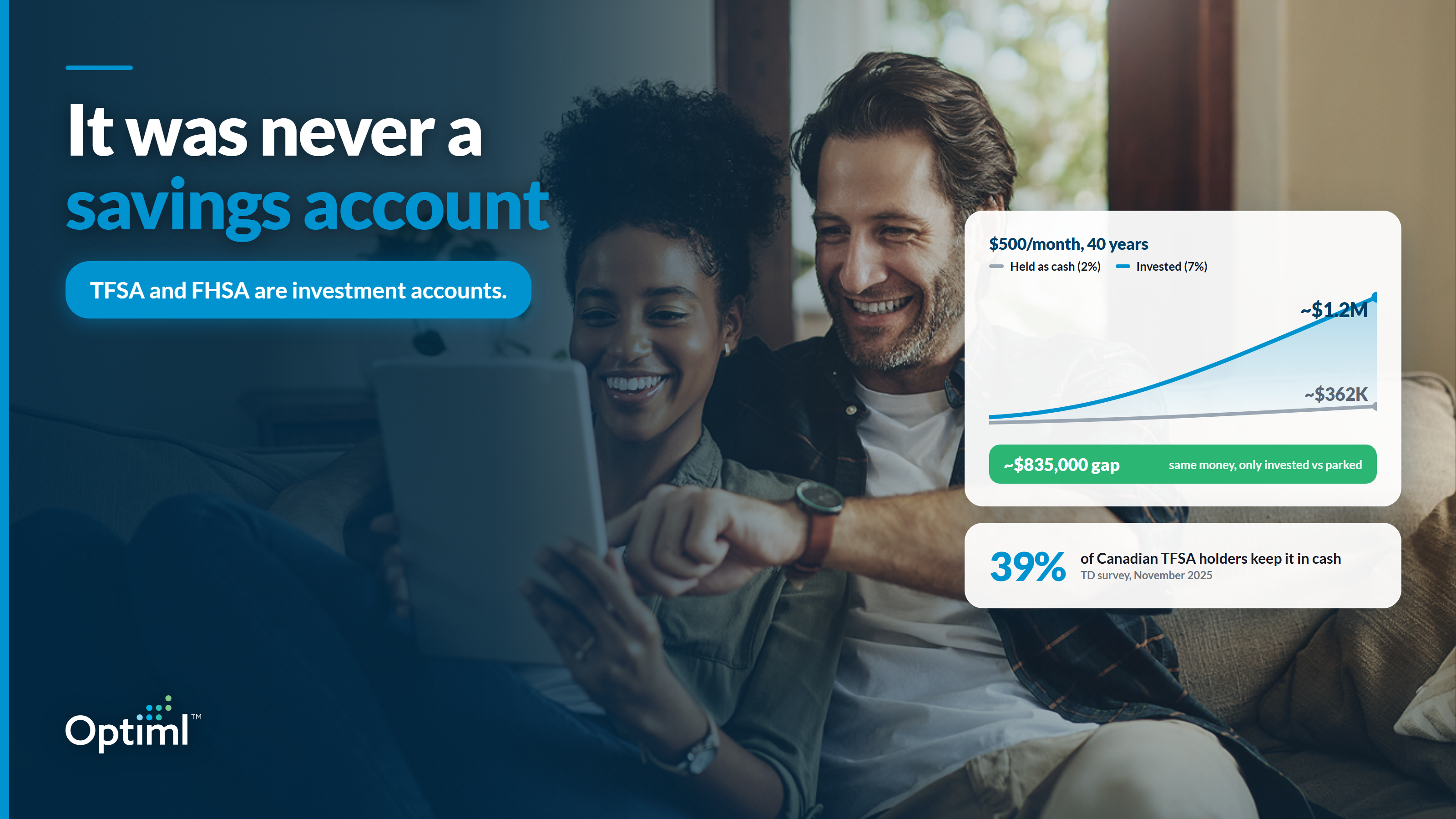
A friend of mine is an engineer. He is precise, numbers come naturally to him, and he reads the fine print on everything. A few months ago he mentioned, almost in passing, that his Tax-Free Savings Account (TFSA) had been sitting entirely in cash for years. Not a few hundred dollars of float. The whole balance.
I asked him why. His answer was honest and, I think, more common than anyone admits. "It says savings account. That's what a savings account is for."
He wasn't wrong about the words. He was wrong about the account. And the gap between those two things has a price tag.
Here is the thesis of this entire post: the TFSA and the First Home Savings Account (FHSA) are investment accounts wearing a savings-account name. The label tells you to park money. The account is built to grow it. For long-horizon money, treating one like the other is one of the most expensive misunderstandings in Canadian personal finance.
It's not just one friend
I could have written this off as a one-person quirk. But the data says otherwise.
A November 2025 TD survey found that 39% of Canadian TFSA holders are not investing the money inside their account. They hold it as cash. Among younger Canadians, that figure climbs to 41%.
Nearly four in ten. These are people who opened the account, who contribute to it, who clearly understand it matters. They just stopped one decision short of using it the way it was designed.
The reasons people give are reasonable on their face. Some want the funds readily available. Some aren't sure what to choose and don't want to choose wrong. Some simply don't feel confident enough to invest. None of that is foolish. But it points at the same root cause my friend named out loud: the word savings does a lot of quiet work, and most of it points in the wrong direction for long-term money.
What these accounts actually are
Let's correct the language, because the language is the problem.
A TFSA is a tax-free investment account. More precisely, it is a wrapper. It is a container that can hold equities, bonds, a balanced or diversified portfolio, Guaranteed Investment Certificates (GICs), or, yes, plain cash. Whatever grows inside it grows tax-free, and whatever you withdraw comes out tax-free. The account doesn't care what you put in it. The word "savings" in the name is describing the tax treatment, not instructing you to hold cash.
For 2026, the TFSA annual contribution limit is $7,000. If you were eligible since the program began in 2009 and never contributed, your cumulative room is roughly $109,000. That is a meaningful amount of tax-free growth space, and growth is the whole point.
The FHSA works the same way, just aimed at a different goal. It is a tax-free investment account designed to help you buy your first home. It carries an unusually generous combination: your contributions are tax-deductible like a Registered Retirement Savings Plan (RRSP), the growth inside is tax-free like a TFSA, and a qualifying withdrawal to buy a first home comes out tax-free. The FHSA limit is $8,000 per year up to a $40,000 lifetime maximum. Same lesson applies: it is a container, and what you hold inside it decides what it becomes.
Both accounts can hold investments. Both are usually called savings accounts. That mismatch is where the money leaks out.
The cost of the label
Let's make this concrete, because abstract advice is easy to nod at and ignore.
Imagine you contribute $500 a month into a TFSA for 40 years. Same person, same discipline, same $500 every month. The only variable is what the money does once it lands in the account.
If it sits in cash earning roughly 2% a year, the kind of rate a High-Interest Savings Account (HISA) might pay over the long run, you end up with about $362,000. If instead it is invested in a diversified portfolio earning a long-run assumed 7% a year, you end up with about $1,198,000.
Same account. Same money in. Same person. The only difference is invested versus parked, and the difference is about $835,000 on $240,000 of contributions.
To be clear about the assumptions: this assumes a constant annual return with contributions made at year-end. The 2% and 7% figures are assumptions, not guarantees. Real returns vary year to year, equities fall as well as rise, and nobody earns a clean straight line. But the shape of the result is not controversial. Over four decades, the gap between cash and a diversified portfolio isn't a rounding error. It's the majority of the outcome.
That is the cost of the label. Not a fee, not a penalty, not a tax. Just a word that quietly answered a question my friend didn't realize he was being asked.
The reframe: there are two decisions, not one
Here is the mental model that fixes this.
Opening and funding a TFSA or FHSA is decision one. Most engaged Canadians get this right. They contribute, they track their room, they feel responsible. Good.
What you hold inside the account is decision two. Cash, bonds, equities, a balanced mix. And decision two is the one the name silently makes for you, in the wrong direction, if you let it. "Savings account" whispers "hold cash," you never consciously revisit it, and forty years later the whisper has cost you six figures or more.
Now, the honest nuance. Cash is not always wrong. Short-horizon money has every reason to sit in cash or a HISA: your emergency fund, or a home purchase you're making in the next year or two. For an FHSA where the home is close, parking is perfectly sensible. The point isn't that cash is bad. The point is that long-horizon money sitting in cash by default is the trap. If the money won't be touched for decades, the name should not be the thing deciding how it's invested.
Where this fits in your plan
The reason this is so easy to miss is that the TFSA and FHSA usually get looked at in isolation, as a balance on a screen. A number that goes up a little each year. Nothing about that view tells you what the money could have become, or what the cost of leaving it as cash will be by the time you actually need it.
This is exactly what we built Optiml to make visible. Optiml models your TFSA and FHSA inside your full retirement plan, not as static cash balances but as growing assets with an assumed rate of return, integrated with your RRSP, Canada Pension Plan (CPP), Old Age Security (OAS), and the order you'll eventually draw everything down. You can see, decades in advance, what "parking it" actually costs you, instead of discovering it the hard way at the end.
Your Success Score stress-tests that full picture against 50 market scenarios, so the assumptions stop being a leap of faith and start being something you can see, adjust, and trust. Change the growth rate on your TFSA from cash-like to invested and watch the rest of your plan respond. That's decision two, made with the math in front of you instead of a word on an account.
The names aren't going to change. TFSA and FHSA will keep saying savings long after this post is forgotten. So the work falls to us: read the account for what it is, make decision two on purpose, and let long-horizon money do the one thing it was put there to do.
It was never really a savings account. It was always an investment account. Treat it like one.
Ready to optimize your retirement plan?
Join thousands of Canadians making smarter financial decisions with Optiml.
Start Free Trial