

If you are an incorporated Canadian, you have probably noticed something about retirement planning tools. They are built for someone else.
Most calculators ask for your RRSP (Registered Retirement Savings Plan), your TFSA (Tax-Free Savings Account), maybe a pension and a home. Then they stop. There is no field for your Operating Company. No place for the Holding Company sitting on top of it. Nothing for the family trust, the corporately held rental property, or the investment portfolio you have been quietly compounding inside the corporation for fifteen years.
So the single largest pool of wealth in your life, the one your entire retirement actually depends on, becomes invisible to your plan.
That is the gap. Business owners are the most underserved group in Canadian retirement planning precisely because their situation is the most complex. Either a tool ignores the corporation entirely, or it treats it as a black box: "assume you pull $80,000 a year out of the company and move on." But how you move money out of a corporation, in what order, taxed in which account, is one of the most consequential set of decisions a Canadian will ever make. It deserves a real model.
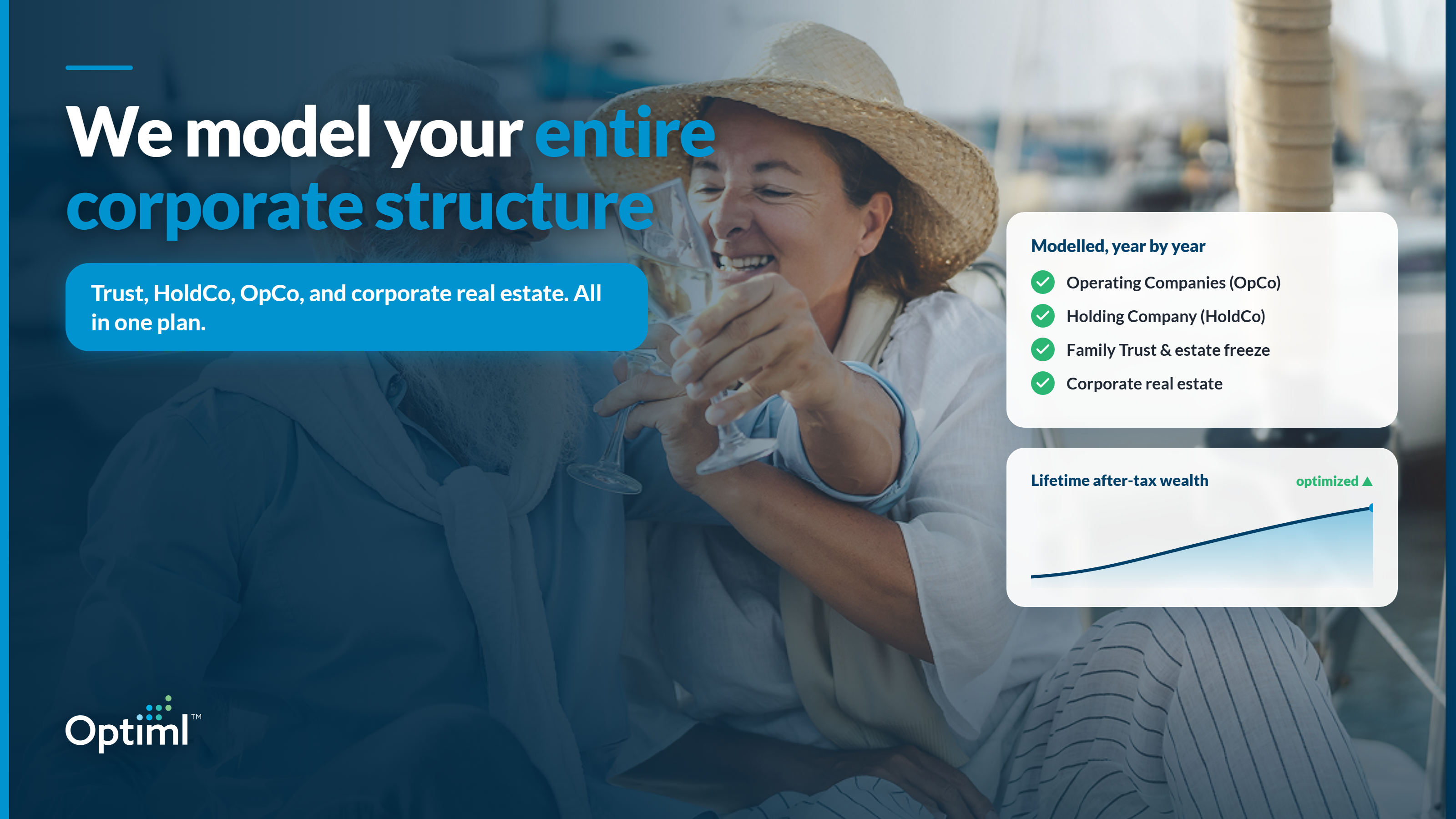
So we built one. Optiml's Legacy plan models your entire corporate structure, year by year, integrated directly with your personal plan. Let me walk you through how deep it actually goes.
Start at the bottom: the Operating Company
The Operating Company (OpCo) is your active business, and Optiml models it as a full CCPC (Canadian-Controlled Private Corporation) with three moving parts: the business value itself (active operations, an annual growth rate, after-tax operating profit), a corporate investment fund, and a cash reserve you can hold to a minimum balance.
Every year, after-tax business profit and investment income flow into operating cash. From there you make the decision every incorporated owner makes: how much comes out as salary, how much as dividends, how much stays invested inside the company. Optiml models that allocation explicitly.
Here is where it gets serious. Optiml tracks the four corporate tax accounts that determine how tax-efficiently you can ever get money out:
- GRIP (General Rate Income Pool) grows with full-rate after-tax income and sets how much you can pay out as lower-taxed eligible dividends.
- CDA (Capital Dividend Account) captures the non-taxable half of every realized capital gain and the credit from corporate life insurance. Everything in the CDA can flow out to you completely tax-free.
- ERDTOH (Eligible Refundable Dividend Tax on Hand) and NERDTOH (Non-Eligible Refundable Dividend Tax on Hand) track refundable tax sitting with the government, waiting to come back to you when you pay the right kind of dividend.
Those accounts are not decoration. They drive a strict dividend distribution priority that Optiml follows in order: shareholder loan repayment first (tax-free), then capital dividends (tax-free, up to your CDA balance), then eligible dividends (lower personal rate, up to your GRIP), then non-eligible dividends (higher rate, but no ceiling). Get the order right and you pull years of income out at a fraction of the tax. Optiml does that sequencing for you.
It also handles Part I tax on the company's passive investment income and Part IV tax on portfolio dividends, including the refundable portion (the so-called additional refundable tax, roughly 10.67% federally) that comes back when dividends are paid. You do not need to track any of that by hand.
And when you eventually sell the business, Optiml models the share sale with the LCGE (Lifetime Capital Gains Exemption), around $1.25M in 2025, on QSBC (Qualified Small Business Corporation) shares. There is a critical wrinkle here that most owners learn the hard way: the LCGE generally requires the shares to be held personally. If the OpCo is owned inside a Holding Company, the exemption is disabled. Optiml shows you that trade-off directly, so the decision about where to hold the shares is made with the math in front of you, not after the sale.
One layer up: the Holding Company
The Holding Company (HoldCo) sits on top of your OpCos and is, for many owners, where retirement wealth actually lives. Optiml models it as its own CCPC, with its own investment fund, cash, life insurance, shareholder loans, and the same four tax accounts.
Dividends flow up from the OpCos into the HoldCo. Optiml distinguishes between connected corporations (where the HoldCo controls the OpCo, typically a wholly owned subsidiary) and portfolio holdings (minority stakes). Both are received through the inter-corporate dividend deduction, so they are not added to taxable income, but both attract Part IV tax at 38.33%. The important part: that Part IV tax is fully refundable. It comes back through the refundable dividend tax on hand system the moment the HoldCo pays a dividend out to you. Optiml tracks every dollar of it across ERDTOH and NERDTOH and refunds it at the right time.
Now the part Optiml owners ask about most: what a HoldCo can actually hold. The answer is a lot more than a stock portfolio, and Optiml models the full range.
- A diversified investment fund, with each income type taxed correctly: interest and foreign dividends as fully taxable Part I income, eligible and non-eligible Canadian dividends routed to the right refundable-tax pool, and capital gains realized proportionally on withdrawal (half taxable, half flowing to the CDA).
- Private equity, modelled as minority stakes that throw off dividends and eventually a capital gain on sale.
- Corporate life insurance, where premiums are paid with corporate dollars and the eventual benefit creates a CDA credit, one of the most tax-efficient ways ever designed to move wealth out of a corporation.
- Real estate. This is the one most tools cannot touch at all.
If you hold rental or income property inside your corporation, Optiml models the rental income, the CCA (Capital Cost Allowance) depreciation you claim against it, the mortgage tracked separately, and the recapture that gets triggered when you sell. If you hold raw land, it models the appreciation, the holding costs, and the capital gain when it is sold. Your corporately held real estate stops being a number you scribble in a margin and becomes a real, taxed, year-by-year part of the plan. For a lot of incorporated Canadians, that alone is the difference between a plan that reflects their life and one that does not.
The top layer: the Trust
For owners thinking about the next generation, Optiml models the family trust structure that holds the HoldCo shares.
The classic move is the estate freeze. You exchange your common shares for fixed-value preferred shares, the trust subscribes for new common shares, and from that point forward all future growth in the company accrues to the trust for your beneficiaries. Your value is "frozen" at the freeze-date amount. Freeze a $2.0M company in 2020 and let it grow to $3.5M by 2025, and your estate still reflects $2.0M while the trust holds the $1.5M of growth for the next generation. Optiml models the freeze, the frozen preferred value, and the growth accruing to the trust.
It also models the rule that catches business families off guard: the 21-year rule. Every 21 years, a trust faces a deemed disposition of its capital property at fair market value. Optiml assumes proper planning around it, a rollout to beneficiaries and a refreeze, and models the automatic refreeze at each anniversary so the structure keeps working across decades rather than detonating quietly at year 21.
And for couples, there is the Joint Partner Trust (a spousal trust). The advantage: no 21-year rule applies while a spouse is alive. Assets roll to the surviving spouse at ACB (adjusted cost base) at the first passing, with no immediate tax. The full deemed disposition is deferred until the second passing. Optiml tracks the ACB through the structure and models the tax event at the right time, not before.
A quick note on language, because it matters to how we build this. Throughout these models we are talking about deemed dispositions, rollovers to a surviving spouse, and the final tax return for an estate. These are tax mechanics, modelled as planning events, framed the way a good planner would frame them: as things you can prepare for, not things to fear.
How the layers fit together
Here is the structure Optiml models, top to bottom:
Now the point of all of it. This entire structure, Trust to HoldCo to OpCos plus the investments and the real estate, flows up and is modelled year by year, then integrated with your personal plan. The dividends that come out of the corporation are the same dividends that fund your RRSP, your TFSA, and your lifestyle. The plan sees both sides at once.
That integration is what makes the outputs meaningful. Optiml shows you your lifetime tax across the corporate and personal sides together. It shows you your after-tax estate through the Estate Projector, modelling the deemed dispositions and the CDA credits that flow at the end. And it stress-tests the whole picture with the Success Score, so you know how resilient the structure is across market scenarios, not just on a good day.
Consider an illustrative owner: 58 years old, a profitable OpCo, a HoldCo holding a corporate investment portfolio and a rental property, and a family trust set up after an estate freeze a few years back. The question is not "can I retire." It is "in what order do I pull money out of all of this, across the next thirty years, to pay the least lifetime tax and leave the most behind." That is not a question a calculator can answer. It is exactly the question Optiml is built to model. And because you can run it through Compare Plans, you can test one structure against another, salary-heavy versus dividend-heavy, OpCo held personally versus inside the HoldCo, side by side, before you commit to anything.
For incorporated Canadians who apply these strategies, the tax efficiency gains are meaningful, typically in the range of 3 to 15% of lifetime tax depending on the structure (illustrative, and specific to your numbers). The real value is not a single figure. It is finally seeing the entire picture in one place.
The bottom line
Your corporation is not a side note to your retirement plan. For most incorporated owners, it is the plan. A tool that cannot model it is not modelling your retirement at all. It is modelling a simplified version of someone else's.
Optiml treats the corporation the way you actually experience it: as a living structure with real accounts, real tax rules, real real estate, and real consequences for the order you do things in. The whole thing, integrated with your personal plan, in one model you control.
Your wealth was built through your corporation. Your plan should be too.
Ready to optimize your retirement plan?
Join thousands of Canadians making smarter financial decisions with Optiml.
Start Free Trial