

The $2 Million Race: The True Cost of Waiting
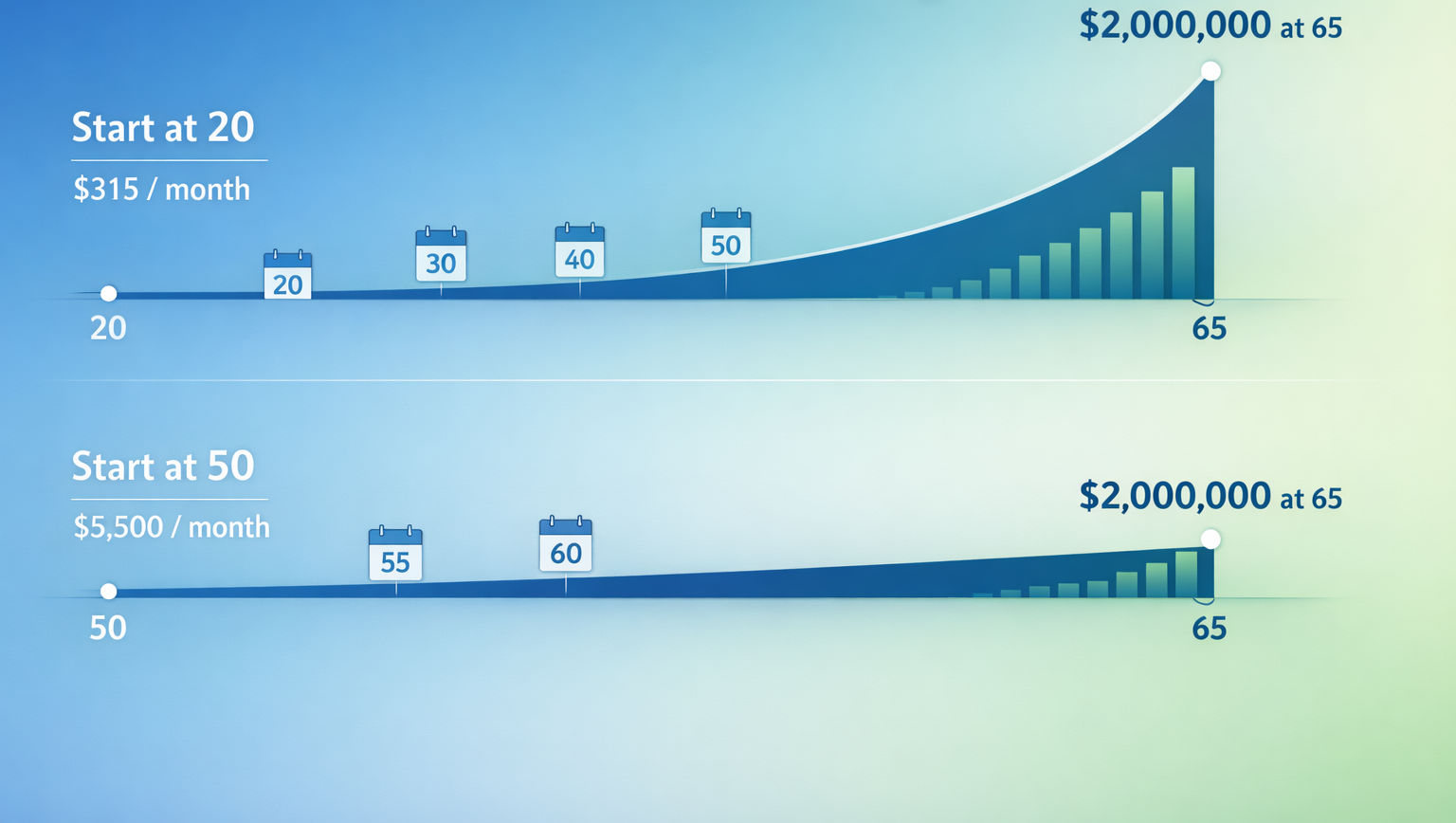
If you invest $315 per month starting at age 20, you can end up with roughly $2,000,000 by age 65.
That’s not a trick. It’s not luck. It’s just time.
And once you see the math, it becomes very hard to ignore.
First—Is 10% Even Realistic?
Yes.
The S&P 500 has returned approximately 10% annually over the last 40 years, despite crashes, recessions, and global uncertainty.
So using 10% isn’t aggressive—it’s historically grounded.
The Proof: $315/Month = $2 Million
Here’s exactly what happens if you start at age 20:
| Starting Age | Monthly Investment | Years Invested | Total Contributions | Value at 65 (10%) |
|---|---|---|---|---|
| 20 | $315 | 45 | $170,100 | ~$2,000,000 |
You put in $170K.
The market does the rest.
This is the entire game: time turns small, consistent investing into massive outcomes.
Now Watch What Happens When You Wait
Same goal. Same return.
The only thing that changes is when you start.
| Start Age | Monthly Needed | Total Contributions | Increase vs Age 20 |
|---|---|---|---|
| 20 | $315 | $170K | - |
| 30 | $820 | $345K | 2x more |
| 40 | $2,100 | $630K | 4x more |
| 50 | $5,500 | $990K | ~6x more |
Nothing changed except time.
Not the market. Not the goal.
Just the decision to wait.
A More Conservative Reality (6% Return)
Let’s lower expectations.
What if returns are only 6%?
The math still tells the same story—just louder.
| Start Age | Monthly Needed (6%) | Total Contributions |
|---|---|---|
| 20 | $1,050 | $567K |
| 30 | $1,900 | $798K |
| 40 | $3,900 | $1.17M |
| 50 | $9,800 | $1.76M |
Even with lower returns, the conclusion doesn’t change:
Time matters more than return.
What This Actually Means
Starting early doesn’t just help.
It fundamentally changes what’s required from you.
- Start at 20 → low effort, high compounding
- Start at 40 → high effort, limited compounding
- Start at 50 → almost entirely dependent on contributions
This is why two people with similar incomes can end up in completely different financial positions.
One gave their money time.
The other didn’t.
The Bottom Line
If you take one thing from this:
$315/month isn’t small when you give it 45 years.
And waiting 10 years doesn’t delay your outcome—it reshapes it entirely.
Because in investing, time isn’t just a factor.
It’s the multiplier.
